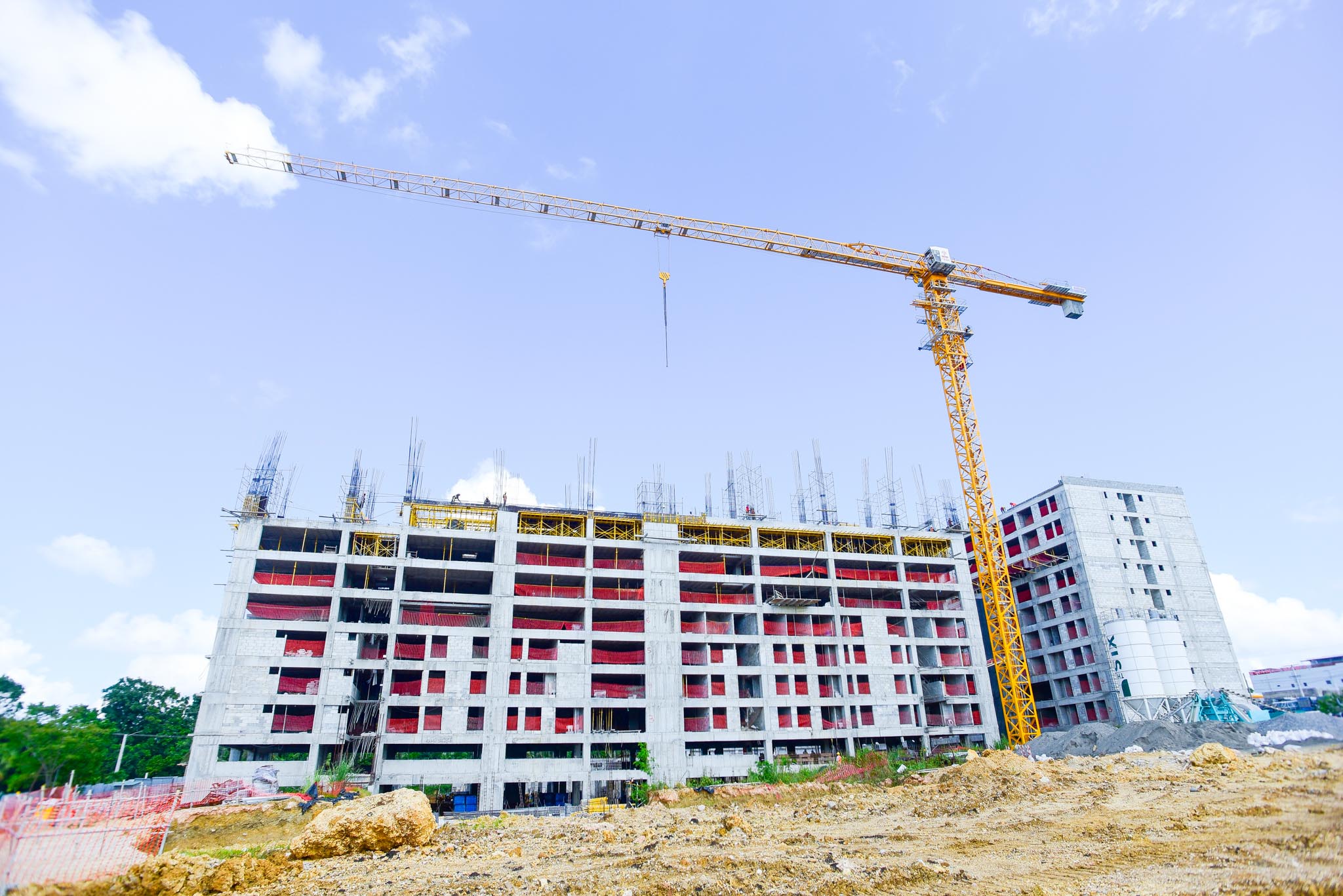
The new construction map is redrawing a Greater Santo Domingo in transformation, where residential development, silent densification, and socioeconomic gaps between sectors are mixed.
SANTO DOMINGO – For the first time in years, the construction sector in the Metropolitan Region reveals a different, more precise, and more geographically focused picture. Certain neighborhoods have become epicenters of construction activity, while others are progressing at a different pace.
This is evident from section II of the Registry (ONE) , which allows us to see with an unusual level of detail a transforming , where residential development, silent densification and socioeconomic gaps between sectors are mixed.
Based on this data, this report delves into the most active neighborhoods, describes why they concentrate so much movement and how their own social fabric influences, and is influenced by, this expansion.
The first thing one notices upon reading the report in detail is that urban growth in the Santo Domingo Metropolitan Region is not uniform . Four neighborhoods stand out for their construction activity: Los Frailes, Los Guaricanos, Piantini, and La Grúa . Each tells a different story about development, inequality, and social transformation.
The middle ones are pushing a silent giant
According to the Siempre Adelante Foundation, 80% of the population of Los Frailes is in the lower middle and 18% in very vulnerable sectors, mainly because the area has received families evicted from other neighborhoods.
This reality has led to a coexistence marked by cultural diversity and social challenges. The local economy is based on jobs in free trade zones, small businesses, and informal work.
Even so, the report reveals that Los Frailes has 239 active construction projects , leading the ranking of building activity in the entire Metropolitan Region.
Its strategic location, on the eastern edge of Santo Domingo Este, near the airport and with access to the Las Américas Avenue corridor, makes this neighborhood a convergence point for housing projects for the emerging middle class, expansions of family homes and mixed-use buildings.
And although it is a neighborhood densified by self-construction, in the last decade it has seen an increase in small and medium-sized formal projects , for a population that is characterized by high labor mobility towards service and commercial areas in the same municipality.
This mix explains why smaller-scale works predominate and why it is also one of the territories with the highest proportion of paralyzed works: these are projects sensitive to variations in material prices, financing, or formalization.
The frontier where development accelerates
Almost next door to Los Frailes, Prado Oriental has 231 active construction projects, a number that reflects its rapid process of becoming one of the areas with the greatest real estate growth in the East of Greater Santo Domingo.
Although it does not appear among the neighborhoods with the largest total construction area, its dynamic volume of construction makes it a key player in the market.
Located very close to Ciudad Juan Bosch, Avenida Ecológica and the new educational and commercial centers, Prado Oriental attracts a young middle-class public looking for more formal housing and gated communities.
It's an emerging sector, with a younger population and more formal employment than nearby traditional neighborhoods. Its growth is linked to the boom in organized residential projects, many under condominium ownership, which explains the steady increase in new construction.
Expansive tradition and constant demand
Thirdly, with 217 active works , Villa Mella continues its historical pattern of high-demand urban expansion, driven by middle and lower-middle income populations, with a well-defined residential layout and increasing accessibility to the National District and Santo Domingo North.
Villa Mella is one of the most populated areas in the country and its volume of construction corresponds more to expansions and new family homes than to large vertical projects.
The social composition is broad: formal and informal workers, large families, and a robust domestic market. This diversity results in numerous projects, but not necessarily large-scale ones.
Density and inequality
Los Guaricanos , also in Santo Domingo Norte, is one of the most densely populated sectors of the municipality, with more than 200,000 inhabitants , and yet it is the absolute leader in square meters built: 632,781 m², displacing historically dominant sectors, although it is not among the neighborhoods with the most construction.
This data reveals that, although there are not as many buildings, those that are being built are on a larger scale: larger projects, multi-story buildings, or residential and commercial complexes.
The jump in built area suggests a change in the profile of the supply: from self-built housing to developer projects.
Traditionally a lower-middle-income neighborhood with a strong presence of young households, Los Guaricanos is changing. Road improvements, the expansion of formal commerce, and population pressure have transformed the area into a new point of interest for medium-sized projects.
Although it is surrounded by natural areas such as Mirador Norte Park, the quality of life varies significantly among its more than 30 sub-neighborhoods, which also face structural challenges.
Los Guaricanos is home to the Duquesa Landfill, which receives more than 90% of the waste from Greater Santo Domingo, generating environmental and social tensions.
Luxury and verticality: the financial heart
Piantini expansion located in the National District, it represents the most exclusive of urban development, with its 472,693 m² in active works , it is a symbol of high-level real estate investment.
This sector is part of the Central Polygon and is characterized by residential towers, premium shopping centers and luxury services, for a population of about 10,000 inhabitants and is a financial and commercial center, which attracts both local entrepreneurs and foreign investors.
Although it does not lead in the number of projects, it is the epicenter of high-cost vertical development: residential towers, corporate buildings and projects with sophisticated amenities.
Piantini has one of the highest densities of capital per square meter, concentrating more invested money there than in most other parts of the city. And it's not about how many projects there are, but how much they're worth: luxury towers, corporate projects, and high-cost buildings that make every square meter of land or construction far more valuable than average.
In short, it is a territory where every piece of space represents a considerable investment, and that is why it becomes a magnet for developers and buyers with greater purchasing power.
It comprises upper-middle and upper classes, with high levels of banking penetration, and is an investment-oriented market. Prices per square meter in Piantini are among the highest in the country, which explains why, even with few developments, its impact on the area is so powerful.
Silent growth in Mendoza
La Grúa, in Mendoza (Santo Domingo Este) , considered the expansion hub of Santo Domingo Este, is linked to housing projects for the growing middle class.
It occupies an important place, with a construction area of 353,973 m² and although it is less well known, its proximity to areas such as San Isidro and Los Mameyes makes it a strategic point for residential development.
It is not a luxury or elite sector, but it is one with urban dynamism and growing real estate investment.
However, studies by MEPyD and SIUBEN identify this area as vulnerable in terms of multidimensional poverty . It is a community comprised of lower-middle and emerging-middle classes, with high social density, cultural diversity (mainly due to the presence of immigrants), and a strong drive for residential development.
What do these data tell us?
The ROE report shows that urban growth in Santo Domingo is driven by very different realities, ranging from working-class neighborhoods seeking to strengthen themselves to elite areas expanding their infrastructure upwards.
Santo Domingo Este, with 2,664 registered buildings , leads in number of works, 35.8% of the total, followed by Santo Domingo Norte, with 1,129 works (16.5%) , and Santo Domingo de Guzmán, with 1,057 works (15.5%) .
This diversity poses challenges for urban planning, territorial equity, and access to services.
The ROE operation covered 163 urban neighborhoods and 5 rural areas of the Ozama region, coverage that allowed the ONE to identify and classify the works according to their status (in plans, execution, paralyzed or completed) and their precise location, using official cartography and direct interviews in the field.
One of the interesting findings was discovering how neighborhoods like La Guáyiga, El Almirante, and El Tamarindo entered the list of the twenty with the most active construction projects this year. These are peripheral areas with low- and lower-middle-income populations, where informal housing in the process of being formalized predominates.
This means that many projects are small extensions, regulated self-builds, and family projects.
The report is not only useful for identifying areas of increased construction. It is also a key tool for making real estate investment decisions; designing public policies for housing, infrastructure, and mobility; and monitoring urban growth and its impact on the environment.
More people, more construction
The territorial snapshot of the ROE 2025-1, corresponding to the first half of the year , reveals a pattern that repeats itself regardless of the municipality: where more people live, more is built . Middle and lower-middle-class neighborhoods, such as Los Frailes, Villa Mella, Guaricanos, and El Almirante, account for the largest number of active construction projects or the greatest volume of square footage built.
These are densely populated areas with high housing demand and a constantly expanding population. In contrast, upper-class neighborhoods like Piantini, Naco, and Paraíso have fewer construction projects, but those that do are much more expensive and have a distinctly vertical character.
Adding to this uneven map is another dividing line: the peripheral municipalities accumulate a large number of stalled works, reflecting fragile family economies and dependence on informal credit, while the faster pace of execution and completion in the National District is a symptom of a more solid market and greater investment capacity.
Overall, the scenario presented by ROE 2025-1 shows us not just one Greater Santo Domingo, but several overlapping ones.
One grows out of necessity, where self-construction or informality and population demand drive every meter built. Another advances through planning and organized developments, and a third is projected through high-impact investment, dominated by towers, amenities, and record prices.
The most active neighborhoods are not so by chance: they respond to demographics, the purchasing power of their residents, the available infrastructure and aspirations for social mobility.
In these contrasts, between expanding peripheries, rising centers, and communities that reinvent themselves, the country's urban future is taking shape, already visible in the new concrete silhouettes emerging between saturated streets and avenues that are still looking for space to grow.