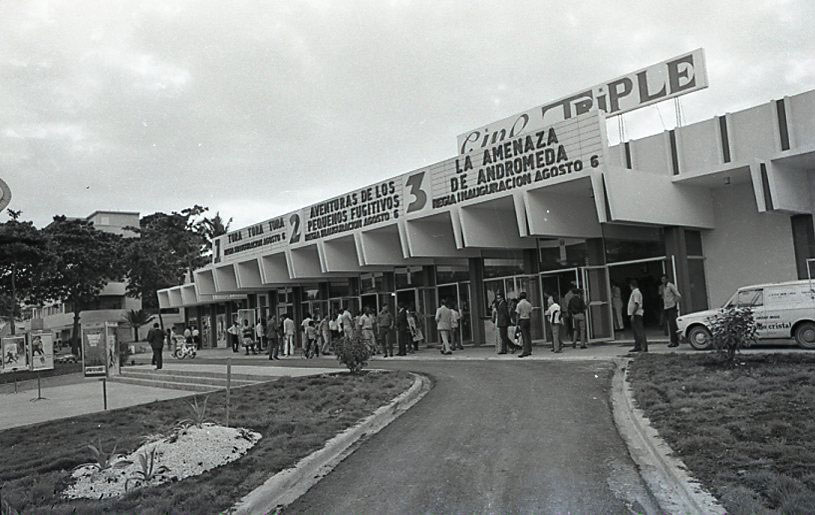
Its architecture was pragmatic, modern, and elegant, with a focus on the collective experience of cinema and urban functionality, rather than ornamentation.
SANTO DOMINGO. – There was something magical about the Malecón afternoons in the early 1970s. It was the place for family Sunday strolls after lunch. At sunset, the sun slowly glided over the waters of the Caribbean, tinting the royal palms orange and casting a luminous silhouette on the concrete benches.
On August 5, 1971, the city of Santo Domingo celebrated the 473rd anniversary of its founding, commemorating 1498, when it was established as a town or city by the Spanish colonizers. That day, a Thursday, also saw the opening of the Triple cinema, the first multiplex in the country, located on the Malecón.
Although it was a weekday, there were many attendees, all dressed in their finest attire. Outside, there were three lines at the box office, and groups of families and friends were learning on the spot how to select the same film.
That day, the three theaters screened Tora! Tora! Tora!, The Adventures of the Little Runaways, and The Andromeda Strain. Each screening was like a portal that transported viewers beyond their streets, their jobs, their routines. From then on, cinema offered not only screens, but also dreams that crossed over at the end of the show to enjoy the foam of the waves.
Its architecture was pragmatic, modern, and elegant, with a focus on the collective cinematic experience and urban functionality, rather than ornamentation. It was a building that "breathed urbanism" and became a cultural landmark of Santo Domingo, leaving its mark both for its innovation and for the understated and efficient style of its spaces.
Although it didn't have surround sound, the auditory experience was part of its magic. The films could be heard clearly from every seat thanks to a modern amplification system for the time and strategically placed speakers in each auditorium.
Meeting point
The Triple Cinema wasn't just for watching movies; it was a refuge for young people, a meeting place for those who shared laughter, secrets, and hidden dreams. It was the site of clandestine rendezvous and first loves.
After the matinees, those Sunday afternoon showings at 3:00, the children left brimming with stories of adventure, innocence, and fantasy, still savoring the popcorn.
Later, in the 80s, the so-called "vermouth" block would become popular on Sunday mornings, when hundreds of teenagers would invade their theaters to see almost always a "comedy" movie, among them "Animal School", "Airplane!", "Superman" or "Star Wars", which were among the most popular titles among 80s teenagers.
They were special, charming screenings, organized by schools and high schools. Who doesn't remember going with schoolmates, little triangles in their pockets to drop into their red soda cups, collecting every laugh, every clap at the end, to raise funds for their high school graduation? The theater vibrated with excitement, everyone together, laughing, dreaming.
The theaters were imposing: two with about 700 seats each, another with about 524. The cinema was often packed to the top of the steps, and the prices were laughable by today's standards: an adult for a double feature on a weekday paid just RD$1.25, children RD$0.75. Quite affordable, considering what that means today.
That combination—the nearby sea, the cool breeze, the creaking seats, the laughter of young people, the excitement of high school graduation—made the Cine Triple more than just a building. It was part of the hearts of those who grew up with those experiences.
From hand to hand
Located on George Washington Avenue (Malecón) in Santo Domingo, next to the former National Conservatory of Music (now occupied by the Ministry of Culture), the theater was created through a partnership between Dominican businessman Marcos Gómez and the American firm Wometco Enterprises, which operated movie theater chains in Florida and Puerto Rico. The combination of their names gave rise to Gometco Dominicana, the company that owned the theater.
In 1986, Cinedom, SA and Inversiones Cinematográficas acquired Gometco Dominicana, including the Naco, Triple, Doble, and Plaza theaters, thus consolidating ownership of these cinemas.
Then, in 2003, businessman Manuel Corripio, of the Corripio Group, partnered with sisters Margarita and Isabel Turull-Mayol to manage the Palacio del Cine chain, which absorbed the operations of the former theaters, including the Triple.
Therefore, the Triple Cinema went through several stages of ownership: from its inauguration by Gometco Dominicana, its acquisition by Cinedom in 1986, to its integration into Palacio del Cine in 2003.
I live in nostalgia
It no longer exists. Its signs no longer illuminate the seafront, but those who experienced it keep it vivid in their memories. Only nostalgia remains for those who knew it. And when you close your eyes, you can still hear the crisp sound of the film reel being wound, see the gleam in the eyes of those waiting for the screening, feel the collective murmur as the lights dimmed in the theater.
Family arguments about what movie to watch, or the scrambling among friends to buy popcorn, soda, and see if there was enough for a chocolate bar.
There, where the waves crashed with a background murmur, Santo Domingo learned to see cinema as a shared ritual: the laughter of the matinees, the boisterous chatter of children during the mid-show, dreaming of their graduation.
Perhaps the theaters have closed, but in the city's memory, the lights of their marquees remain. Because there are places that stay with us not because of their walls, but because of the emotion they ignited in our lives.
For many years, it was a unique atmosphere where every screening was a small, shared ritual . There, facing the Malecón and under the Caribbean light, one learned to experience cinema as a collective, intimate, and memorable moment.