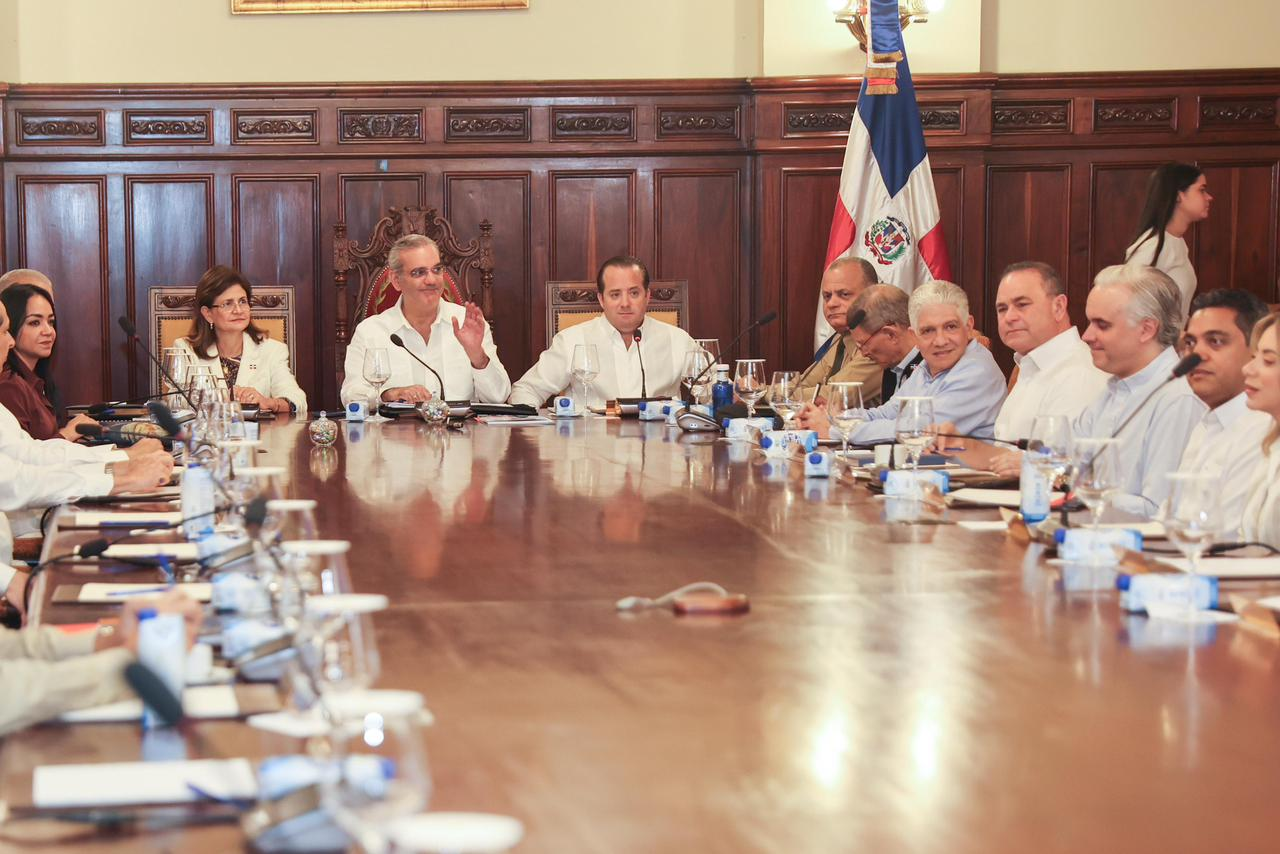
Budget, public investment and social spending are the priorities defined by the Executive in an extended Council of Ministers, which served to align goals, projects and strategic sectors in a context of political pressure for results and efficiency.
SANTO DOMINGO. – The Dominican government yesterday defined its main investment and management priorities for 2026, focusing on the budget, public investment projects and social spending, with an emphasis on infrastructure, education, health, housing and security.
This was established after the Council of Ministers headed by President Luis Abinader, convened to align institutional plans, presidential goals and resource allocation, according to information released by the Presidency of the Republic and the Ministry of the Presidency.
The meeting, held at the National Palace, served as a strategic coordination space for the Executive branch, in which ministers and directors reviewed sectoral priorities and monitoring mechanisms, in what the Government presents as its roadmap for 2026, according to official statements.
Budget: the basis
The central focus of government planning for 2026 is the General State Budget, approved and submitted to Congress with an amount of around RD$1.84 trillion, according to official data from the Ministry of Finance and the Ministry of the Presidency.
It concentrates a significant proportion of spending on social services and investment projects, maintaining macroeconomic stability as a principle, defined by the Executive itself as a non-negotiable condition for growth and attracting investment.
According to official information, the budget design seeks to ensure that political priorities translate into effective implementation, one of the main citizen demands and one of the recurring points of criticism from the political opposition in recent months.
Investment: infrastructure, housing and basic services
Second in importance, the Government prioritizes public investment projects, especially in infrastructure, drinking water, sanitation, transport and housing , with a double impact objective: to boost the economy and generate employment, while improving the quality of life of the population.
The Ministry of the Presidency and the Ministry of Housing, Habitat and Buildings are among the institutions called upon to execute key urban development and social housing projects, with an emphasis on reducing the housing deficit, estimated at more than 1.4 million units, and strengthening territorial cohesion, according to official government planning documents.
Monitoring and evaluation framework
The extended Council of Ministers also allowed for monitoring of the so-called presidential goals, which serve as the Government's internal roadmap for the 2024-2028 period. These goals guide the allocation of resources, prioritize projects, and serve to evaluate institutional performance, as explained by the Presidency in previous communications.
The Executive seeks to have each ministry link its planning and budget to these goals, with monitoring mechanisms that will allow progress to be measured and deviations corrected, in response to demands for greater efficiency and accountability.
Education: greater weight in social spending
Education remains the top priority, receiving the largest budget allocation. The Ministry of Education accounts for one of the highest portions of public spending, in line with the long-standing commitment to dedicate a significant percentage of the budget to this sector, according to official data included in the draft budget and released by the Government.
The priorities include school infrastructure (with an impact on construction), educational quality and strengthening of the public system, aspects considered strategic for the development of human capital and the competitiveness of the country.
Safety and health: social and economic sensitivity
Citizen security and public health complete the core of the Executive's social priorities.
In terms of security, the Government maintains its commitment to police reform and the modernization of prevention and control systems, recurring themes in Council of Ministers meetings and in official statements by President Abinader.
Beyond its direct impact on coexistence and public perception, security occupies a strategic place in the Government's roadmap due to its relationship with the protection of investment.
From the Executive's perspective, stability and citizen security are necessary conditions to guarantee the continuity of infrastructure projects, real estate development and the attraction of private investment, both national and foreign, an approach that has been reiterated in official communications from the Presidency and in proposals from the Security Cabinet.
In health, the budget includes resources to strengthen the hospital network and expand service coverage, a line of action that the Executive has reiterated as essential to reduce gaps and respond to persistent social demands.
Results under scrutiny
The definition of this roadmap for 2026 comes in a political context marked by scrutiny of the government's capacity to execute, rather than simply plan. Opposition sectors and analysts have questioned the slowness or scope of some programs, while the Executive insists that inter-institutional coordination and spending control will be key in this new phase.
Abinader seeks to strengthen the implementation of public policies and thus respond to the questions from opposition sectors about government efficiency and transparency, in addition to sending a signal of order, alignment and focus on results, by placing budget, investment and social spending as central pillars of his economic and political strategy.
The priorities defined in this extended Council of Ministers translate into mandatory mandates for all institutions, indicating an intention to centralize and make public management more rigorous for the remainder of the term.
In political terms, this is also interpreted as an effort to strengthen the legitimacy of the Executive and to demonstrate tangible results in key sectors such as education, health and security, areas with a direct impact on citizens' perception of state management.