


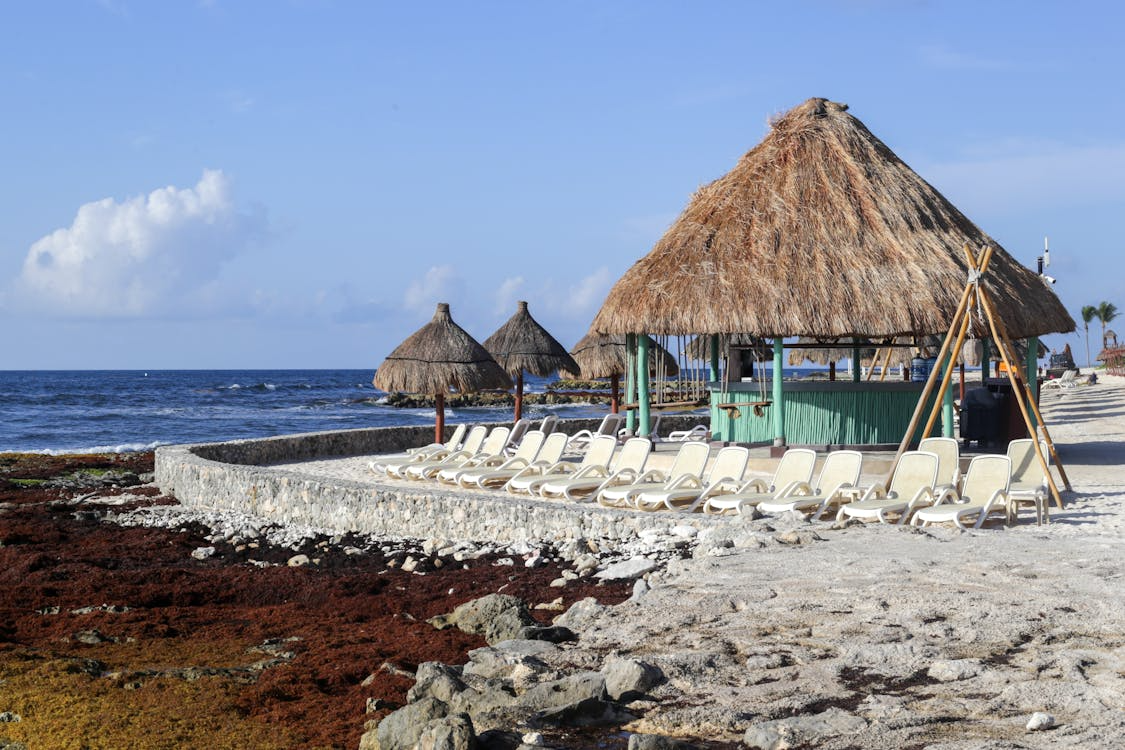
The high levels of sargassum since the beginning of the year anticipate an intense season in the Caribbean, with possible effects on tourism and property values in coastal areas of the Dominican Republic
SANTO DOMINGO. – The accumulation of sargassum in the tropical Atlantic and the Caribbean points to a high intensity in 2026, with foreseeable impacts on the Dominican coasts, particularly in tourist centers where the environmental quality of the beaches influences the real estate market.
The latest data from the University of South Florida Optical Oceanography Laboratory confirm that the season began with “unusually high” levels from the early months of the year, a sign that has historically been associated with severe seasons.
In its most recent bulletin, corresponding to March 2026, the laboratory reports that the total amount of sargassum in the Atlantic and Caribbean remains well above the historical average for this time of year, with extensive concentrations in both the eastern and western Atlantic and the Caribbean.
They do not speak of a single global figure verifiable in tons in real time (those aggregate figures are usually external estimates or secondary interpretations, not the direct data from the satellite bulletin).
In 2025, the University of South Florida laboratory's satellite monitoring system recorded up to 37.5 million tons of sargassum in the tropical Atlantic and Caribbean, the largest volume observed since records began in 2011, with an uneven distribution that fueled influx episodes in the eastern and western Caribbean.
An early start that foreshadows pressure
The behavior observed in the first quarter of the year reinforces a pattern that has been repeated in recent years: when levels are high from January and February, the Caribbean usually faces significant arrivals between May and August, the critical period for tourism.
Satellite monitoring indicates that the sargassum masses continue to move westward, driven by ocean currents, increasing the likelihood of impact on the Greater Antilles, including the Dominican Republic.
The USF confirms the presence of sargassum in the western Atlantic and the Bahamas, which explains visual reports in areas like Miami Beach. However, the bulletin does not quantify the impact per beach nor define it as a “uniform mass event,” but rather as variable arrivals dependent on wind and local currents.
And although the report does not break down by country, the geographical position of the Dominican Republic places it directly in the path of these currents, which historically translates into accumulations in the eastern and northeastern strip.
The main mass is still moving from the Atlantic, and yet the sargassum is already reaching Florida. The Caribbean, including the Dominican Republic, is now entering the peak season.
Impact beyond tourism
Based on the regional dynamics described by the laboratory, the areas at greatest risk continue to be Punta Cana and Bávaro, the coasts of La Altagracia in general, Samaná and part of the north coast.
These areas concentrate a significant portion of tourist real estate investment, making sargassum an increasingly relevant factor for developers, hotel operators, and buyers.
The phenomenon is no longer perceived only as an environmental or seasonal problem, and its persistence has begun to influence investment, maintenance, and operation decisions for coastal real estate projects.
The accumulation of sargassum impacts the visual quality and recreational use of beaches, the cleaning and handling costs for hotels and residential properties, as well as the perceived value of beachfront properties.
In markets like the Dominican Republic, where the appeal of the beach is a central focus of the offering, these factors are beginning to be integrated into the risk analysis.
A structural, not a temporary, phenomenon
Since 2011, scientists have identified the formation of the so-called Great Atlantic Sargassum Belt, a band that extends from Africa to the Caribbean and whose annual variability is influenced by water temperature, nutrients that arrive with pollution and climatic conditions.
The University of South Florida Optical Oceanography Laboratory warns that the system remains active and highly productive, which explains the recurrence of intense seasons in recent years.
Outlook for 2026
Based on current levels and observed trends, everything points to the season being active or above average, with impacts that could extend for several months and the peak remaining in the summer, as usual.
For the real estate sector, this implies the need to incorporate sargassum not as an anomaly, but as a structural variable in the planning and management of coastal projects.
Recommended readings:







