
SANTO DOMINGO – The Central Bank of the Dominican Republic (BCRD) has made available to the general public and economic agents the results of the project to change the reference year (PCR) of the Dominican Republic's national accounts, establishing 2018 as the new reference year for the Dominican Republic's System of National Accounts.
In this regard, the new annual series for gross domestic product (GDP) for the years 2018-2020 have been published, as well as the high-frequency series for quarterly GDP and the monthly indicator of economic activity (IMAE) for 2018-2024 associated with the new reference year. These series are available on the institution's website, www.bancentral.gov.do, in the real sector section of economic statistics, along with a presentation summarizing the main results.
The national accounts were prepared in accordance with the guidelines contained in the System of National Accounts 2008 (SNA2008), a manual sponsored by the United Nations (UN), the European Economic Commission (EEC), the Organisation for Economic Co-operation and Development (OECD), the International Monetary Fund (IMF), and the World Bank (WB), according to a statement from the Central Bank
of the Dominican Republic (BCRD). Similarly, the International Standard Industrial Classification (ISIC) Revision 4 and the Central Product Classification (CPC) Version 2.1 were taken into account in the development of the new national nomenclature of products and economic activities of the Dominican Republic (NNPA). For the estimation of the economic indicators series, quarterly GDP and the Monthly Index of Economic Activity (IMAE), the recommendations of the IMF's 2017 Quarterly National Accounts Manual were adopted.
The BCRD was supported by international consultants and experts endorsed by the UN and with extensive experience in national accounts missions. The institution also received expert advice on National Accounts through the Regional Center for Technical Assistance in Central America, Panama, and the Dominican Republic (CAPTAC-DR), an IMF unit.
This change in the reference year aligns with international recommendations suggesting a periodic update of national accounts approximately every 10 years. This practice allows for the incorporation of variations in relative prices over time, new sources of information, advances in technological processes, and new products in the economy, reflecting transformations in the country's economic structure.
The implementation of the reference year change project was based on significant statistical research, including the updated National Household Expenditure and Income Survey (ENGIH 2018), the 2022 National Population and Housing Census, the National Survey of Micro, Small, and Medium Enterprises (ENMIPYMES), and other specialized sectoral surveys.
Furthermore, detailed information sources were used for the conglomerate of productive sectors: comprehensive research on companies representative of the market's economic activities, various administrative records of companies and public institutions, financial statements and budget execution reports of the general government, and statistics compiled and processed by the Central Bank of the Dominican Republic (BCRD) (Consumer Price Index Survey, National Continuous Labor Force Survey, Tourism Expenditure and Motivation Survey, National Health Survey, and External Sector Statistics).
It is worth noting that this new reference compilation includes supply-use tables comprising 70 economic activities; comparatively, this represents a much greater level of detail than the tables published in the previous reference, which were broken down into 35 activities. The development of the national nomenclature of products and economic activities took into account the degree of relevance and the availability of information for each product at the national level in order to track those with a significant impact on the Dominican economy.
Furthermore, the new national accounts reveal that services have continued the trend observed in recent decades of increasing their impact on the economy. Their share of GDP reached 62.5% in 2018, representing a change of 5.6 percentage points compared to 2007. Within this sector, significant increases were recorded in the GDP share of trade activities, which rose from 9.1% in 2007 to 10.9% in 2018, real estate and rental activities (from 7.7% to 8.7%), and other market service activities (from 8.0% to 8.5%).
The results indicate that construction increased its contribution to GDP from 10.4% in 2007 to 11.6% in 2018. This is due to greater diversification in infrastructure works, with a greater participation of residential projects, which was verified in research carried out for this sector, as well as through surveys corresponding to the cost structures by type of work and valuation of the buildings. Furthermore, by expanding the coverage of information sources, more detailed data was available for estimating the production of specialized construction services (subcontracting), leading to a recomposition of the products of this activity.
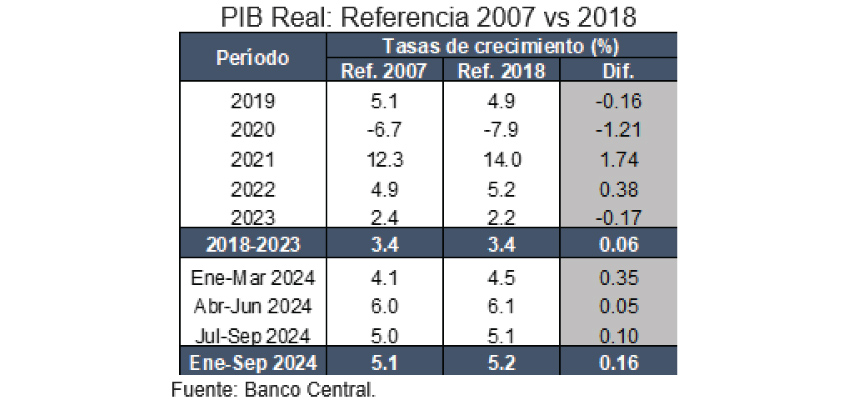
The national accounts associated with the new reference year show an average real GDP growth rate of 3.4% for the period 2018-2023, which is equal to the average real expansion reported during that five-year period using national accounts referenced to 2007.
It is worth noting that both the recession caused in 2020 by the COVID-19 pandemic and the recovery in 2021 were more pronounced in real terms, showing similar average real growth in subsequent years, including the first three quarters of 2024. Nominal GDP at the end of 2024 is projected to be around US$124.5 billion, as in the case of the national accounts for the previous reference year, although with Changes in the composition of value added in different economic activities.
Regarding the recent performance of the Dominican economy, real GDP growth under the new quarterly accounts referenced to 2018 shows an average year-on-year variation of 5.2% in January-September 2024, which was slightly higher than the 5.1% recently announced for real GDP in the same period, calculated using the previous reference year of 2007.
It is important to highlight that a new feature in the compilation of the quarterly national accounts is the distinction of professional services as an individual activity, separate from other market service activities.
These new national accounts are yet another example of the Central Bank's ongoing efforts to update its statistical database. This commitment reflects a strict adherence to the value of transparency and underscores the importance of the timely dissemination of key officially published data. This commitment has been recognized by international organizations that govern regulations and set guidelines for countries to implement.
In this regard, Minsuk Kim, Deputy Chief of the Statistics Division of the IMF, recently praised the Dominican Republic's "exemplary performance" under the Enhanced Generalized Data Disclosure System (e-GDDS) and thanked the Central Bank of the Dominican Republic (BCRD) for its support of IMF initiatives to promote data transparency. He stated that "this strong performance clearly demonstrates the Dominican Republic's commitment to quality statistics and its capacity to implement the necessary changes.".
Finally, the Central Bank highlighted that as part of the products associated with the reference compilation, there are currently ongoing works such as the preparation of the Integrated Economic Accounts (CEI), the Cross Classification Industry-Institutional Sector (CCIS) and the homogeneous 1991-2024 series of quarterly Gross Domestic Product (GDP), which will be published at a later stage along with additional methodological details on the preparation of the reference year change of the National Accounts.
He gave special thanks to all those companies and public and private institutions, researchers and specialists who have provided support by supplying the information that made possible the results of the publication that is being released today.