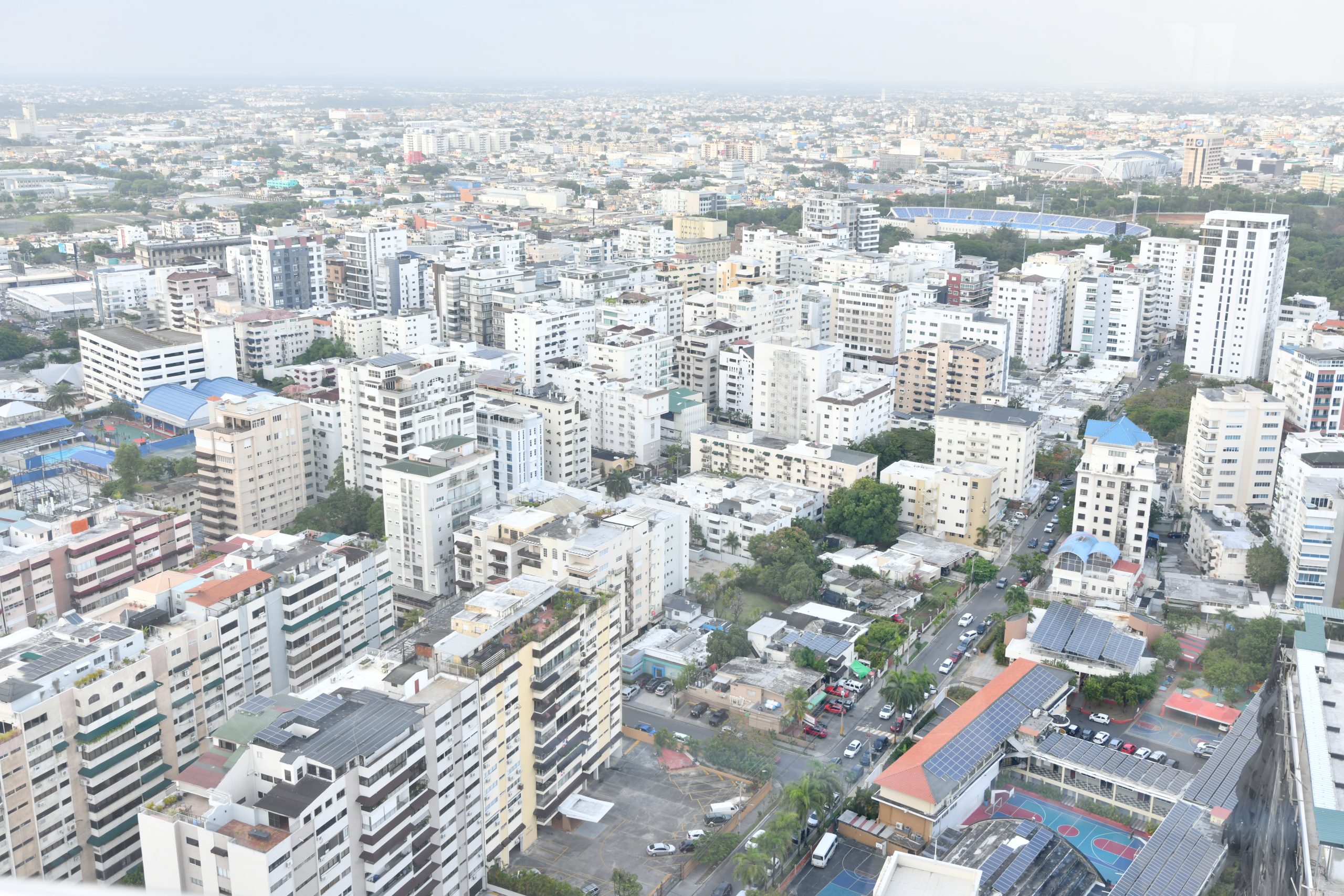
National District of the Dominican Republic. Justo Feliz/El Inmobiliario.
It remains among the Latin American and Caribbean economies with the highest projected growth.
The World Bank lowered its projection for the growth of the Dominican economy in 2025 by 0.7 percentage points, which it had released last January, decreasing the real gross domestic product (GDP) from 4.7 to 4.0%.
However, the country remains among the fastest- growing Latin America and the Caribbean , "as it benefits from structural reforms aimed at attracting foreign investment," according to the World Bank growth rate of 4.3% for 2026-2027
In its World Economic Outlook report, released today, the World Bank says that Latin America and the Caribbean face a scenario of moderate and uneven growth in 2025, in a global context marked by the resurgence of protectionism, political uncertainty and trade tensions with the United States.
According to the World Bank growth is expected to remain stable at 2.3% in 2025 and increase slightly to 2.4% in 2026, as growth weakens in most economies, except for Argentina , Colombia , Ecuador and the Caribbean .
Mexico , the economy most integrated with the US, will be particularly affected by the new trade barriers imposed by Washington, with tariffs of 25% on products that do not comply with the USMCA.
This situation has increased uncertainty surrounding the bilateral relationship, at a time when around 80% of Mexican exports are destined for the US market .
Mexico and the Caribbean, the most vulnerable to US protectionism.
Mexico 's heavy reliance on North American supply chains makes it the most vulnerable in the region .
Mexico 's real GDP growth forecast for 2025 was revised significantly downwards, from 1.5 percentage points to 0.2% in 2025, and the country will grow by 1.1% in 2026.
Manufacturing exports will decline, and although interest rates are falling, they are expected to remain high. This monetary policy, coupled with a shrinking fiscal deficit , will limit the expansion of domestic demand.
Central America and the Caribbean Central American economy is projected to grow by 3.5% in 2025 and 3.6% in 2026, supported by service exports and improved consumption.
Costa Rica leads with a projected real GDP growth
Panama , for its part, would reach 3.5% in 2025 and an average of 4% in the following two years, thanks to the rebound in trade of services linked to the Canal.
In the Caribbean , the most outstanding case is that of Guyana , whose real GDP will expand by 10% in 2025 and an average of 23.65% in 2026-27, driven by investment in oil .
The Dominican Republic also shows strength, with 4% in 2025 and 4.3% in the following two years, while Jamaica would have moderate growth , averaging 1.7% between 2025-2027.
- Haiti 's economic prospects remain fragile and highly uncertain amid persistent political instability and security challenges, with the economy expected to contract by 2.2% in 2025.
Argentina , Colombia and Peru: disparate dynamics
The World Bank projects that Argentina will return to growth this year with a rate of 5.5%, after two years of recession. The recovery will be driven by agriculture, energy, and mining, and will be supported by macroeconomic stabilization policies, the elimination of exchange controls, and pro-market reforms.
growth is expected . The Argentine government plans to maintain sustained fiscal surpluses in line with its program with the IMF.
Colombia is also on track for a moderate recovery growth of 2.5% in 2025 and an average of 2.8% in 2026-27. This improvement is based on a rebound in private consumption and a slight recovery in investment, supported by more relaxed monetary conditions and continued downward inflation.
Even so, political and economic uncertainty could hinder a more robust recovery
growth is projected at 2.9% in 2025 and an average of 2.5% in subsequent years. Weak domestic demand, uncertainty surrounding national policies, and fiscal consolidation explain this moderation.
However, mining investments —especially in copper— and infrastructure projects will provide an anchor for growth .
Brazil and Chile face internal and external challenges
Brazil , the largest Latin American economy, will face a significant slowdown : from 3.4% in 2024 to 2.4% in 2025, and an average of 2.2% in 2026-27.
Lower investment and weaker consumption are weighing on growth , although the reduction in interest rates (from 13.75% to 10.5%) should alleviate some inflationary pressures. Fiscal sustainability will be key to stabilizing the Brazilian economy, which still faces market uncertainty.
In Chile growth is projected at 2.1% in 2025 and an average of 2.2% in 2026-2027.
The report highlights an expected recovery in domestic demand and mining investment in Chile , especially in copper and aluminum. However, institutional uncertainty persists, which could hinder investment, particularly in mining and technology.
Structural factors hinder regional growth
The World Bank warns that, despite an recovery , Latin America and the Caribbean will remain the slowest- growing region among emerging market and developing economies (EMDEs). Factors such as low productivity, a less educated workforce, and an aging population weigh on the long-term outlook.
The region also faces macroeconomic risks . More than half of the Latin American and Caribbean economies have seen downward revisions to their growth .
Inflation, although declining, remains above central bank targets, and interest rates will remain high to consolidate fiscal stability. This environment will limit the scope for expansionary policies in the short term.
Furthermore, the deterioration of public finances following the pandemic and higher borrowing costs could force more severe adjustments than anticipated. The report warns that these cuts could have contractionary effects on regional growth
Dependence on China and the US, key to the economic future
Economic relations with China also strongly influence the projections. A slowdown in Chinese demand—especially for metals—would affect commodity prices such as copper, with direct impacts on Chile and Peru.
For its part, any contraction in US growth would have negative multiplier effects in Mexico, Central America and the Caribbean, particularly due to the drop in remittances, tourism and exports.
Latin America and the Caribbean remain highly vulnerable to global fluctuations. Despite some positive signs, such as Argentina's recovery and the resilience of Guyana and the Dominican Republic, the report concludes that internal structural challenges, coupled with external trade tensions, will continue to shape the course of a still uncertain recovery.
Sources: EFE and Diario Libre.