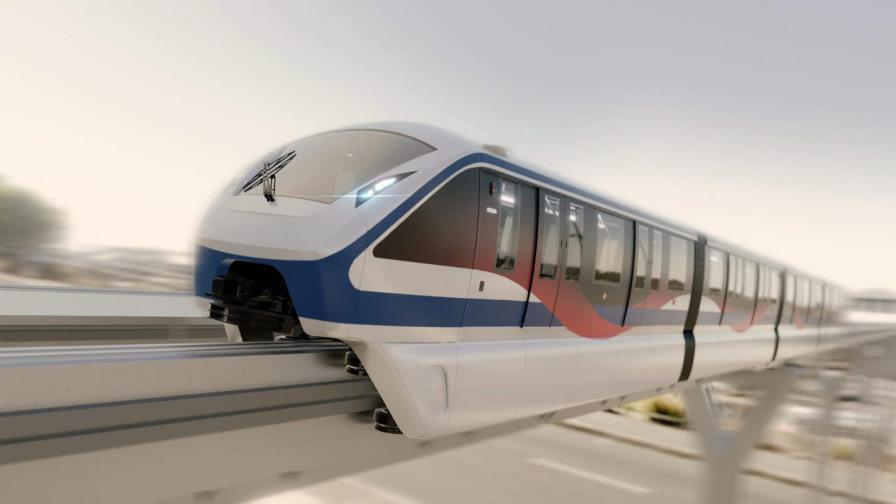
It includes 12 stations and will connect with lines 1 and 2 of the Santo Domingo Metro.
SANTO DOMINGO. – Crossing the Las Américas highway and 27 de Febrero Avenue and financed 85% by the French government , the Dominican government announced yesterday, Thursday, August 28, the construction of the Santo Domingo monorail, one million people in its first stage adding to the solutions for the country's public transportation.
President Luis Abinader provided the details, explaining that the bidding process for the project will begin next week . It will be managed by the Trust for the Development of the Mass Transit System of the Dominican Republic (Fitram).
In a meeting with media directors, the president explained that this project adds to the 35 kilometers of collective transportation solutions built by his government so far, which equals the 34 kilometers that existed previously.
He noted that this will be in addition to the 10.5 kilometers of the route planned for the Monorail, which is intended to cover the route between Charles de Gaulle Avenue and Las Américas Avenue and the vicinity of the Juan Pablo Duarte Olympic Center.
He explained that the project will be part of the Santo Domingo Integrated Transportation System (SIT-SD) to create a network with a high level of intermodality and connections to complementary services. This network will include a Metro, cable car, and monorail, and will be complemented by feeder routes from the Metropolitan Office of Bus Services (OMSA).
The CEO of Fitram, Jhael Isa, the entity that will be in charge of executing the project, explained that the Monorail will cross several areas of the city where the Metro does not provide services, crossing the Las Américas highway and the 27 de Febrero avenue , and will be able to serve an estimated population of one million people.
In its second stage, the Monorail would extend towards Pintura , connecting to Line 3 of the Cable Car, and in a third phase, towards the Duarte highway, connecting with Line 2C of the Los Alcarrizos Metro.
In its first stage, the project will serve a population of more than 1 million inhabitants between Santo Domingo East and the National District, and will meet an initial demand of 12,500 passengers per hour in each direction, in its busiest section, and 306,000 passengers per day .
The initial operation will feature four-car with a capacity of 562 passengers per combination, offering a service of 22,480 passengers per hour in each direction, with a 90-second interval between trains . The system is designed for future expansion to include six-car trains, reaching capacities of up to 34,160 passengers per hour in each direction, adapted to the projected growth in travel demand in Santo Domingo East.
The monorail option was selected due to the cost savings offered by elevated construction, compared to the mining tunnel required by other rail systems, resulting in approximately 35% savings . Furthermore, the project is expected to increase ridership by serving the following areas: Los Frailes, Ensanche Isabelita, Los Mameyes, Los Tres Ojos, Ensanche Ozama, Alma Rosa, Maquiteria, Villa Duarte, Villa Francisca, San Lázaro, San Carlos, Ciudad Colonial, Villa Consuelo, Don Bosco, Miraflores, Villa Juana, and the Santo Domingo metropolitan area, including the neighborhoods of Naco, Esperilla, El Vergel, and Evaristo Morales.
The Santo Domingo Monorail is planned to be built in three phases : Priority section, phase 1, from the Olympic Center, connecting with Metro Line 1 and Line 2 to the King Juan Carlos Bridge on Las Américas Avenue, in Santo Domingo East; extension phase 2, from the Olympic Center to Pintura via 27 de Febrero Avenue, connecting with the future tram and cable car Line 3 Santo Domingo West; and extension phase 3, from Pintura to the extension of 27 de Febrero Avenue, connecting with Line 2 of the Santo Domingo Metro.