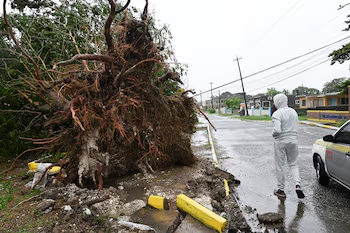
Hurricane Melissa has reached Cuba, after hitting Jamaica with great intensity, a country that has been declared a "disaster zone" by its Prime Minister, Andrew Holness.
BBC News Mundo
The powerful hurricane made landfall near the province of Santiago de Cuba, in the southeast of the island, in the early hours of Wednesday with a category 3 and "sustained" winds of up to 193 km/h, reported the United States National Hurricane Center (NHC).
The storm reached Cuba after crossing Jamaica this Tuesday as a category 5 phenomenon with winds that reached speeds of up to 295 km/h, which made it the strongest to have affected this Caribbean island of 2.8 million inhabitants and where the damage it has left in its wake is still being assessed.
Although the phenomenon has weakened, the NHC has warned that the situation remains "extremely dangerous" and poses "a risk to life.".
He also urged residents of Cuba, where up to 63 cm of rain is forecast, to seek shelter immediately. Local authorities, meanwhile, have evacuated more than 700,000 people on the island.
Before the hurricane made landfall in Jamaica, Melissa's rains and winds had already claimed seven lives: three in Jamaica, three in Haiti, and one in the Dominican Republic.
The devastation in Jamaica
Preliminary damage reports from Jamaica indicate damage to at least six hospitals, numerous flooded roads, and thousands of downed trees and power poles, but due to communication difficulties and power outages, the true extent of the disaster is not expected to be known for several days.
"The reports we have received so far include damage to hospitals, homes and commercial properties, as well as damage to our road infrastructure," Prime Minister Holness told CNN, Reuters reported.
The president stated that the government had not received any confirmation of fatalities related to the storm, but given the strength of the hurricane, "we expect there will be some loss of life.".
Richard Vernon, mayor of Montego Bay, the island's second largest city, expressed similar sentiments.
"The first thing we're doing is making sure everyone is alive," the official told BBC Breakfast.
The latest data shows that Melissa is not only the most powerful storm in the world so far this year, but will be "the storm of the century" for Jamaica, according to the World Meteorological Organization (WMO).
Authorities say Melissa is the strongest hurricane to hit Jamaica since records began 174 years ago.
The previous record was held by Hurricane Gilbert, which struck the island in 1988 and caused 49 deaths.
Tamisha Lee, president of the Jamaican Rural Women Producers Network (JNRWP), a partner of the humanitarian organization CARE International, said that fear on the island "is real but our preparedness is helping us to control it.".
According to Lee, the rescue efforts after the storm will be a marathon, not a sprint.
Given the expected extensive infrastructure damage, which will render roads impassable, Lee stated that the JNRWP will face difficulties delivering aid. Without electricity, communication will also be a problem, he added.
"Based on the forecast and what we've been experiencing since Sunday night, I anticipate the damage will be enormous," he admitted.
Mike Brennan, director of the NHC, told BBC News that after the storm passes over the island, the environment will be extremely dangerous, with downed trees and power lines and significant structural damage, especially in western Jamaica.
Wildlife also poses a threat. Flooding could displace crocodiles from their natural habitats, Jamaican health officials reported.
"The rising water levels in rivers, ravines, and swamps could cause crocodiles to move into residential areas," the Southeast Regional Health Authority said in a statement.
"Therefore, residents living near these areas are advised to remain vigilant and avoid flooding.".
Meanwhile, the UK government has asked British tourists who were on holiday on the Caribbean island to stay in their hotels and follow the instructions of the authorities.
The worst in years
After hitting Jamaica, Melissa reached Cuba through the southeast, through the city of Chivirico, the NHC reported.
Initial reports indicate that flooding is occurring, which should not be surprising, because the Cuban Meteorological Institute (Insmet) had predicted that the hurricane would leave up to 450 liters of water per square meter and cause storm surges with waves up to eight meters high.
BBC meteorologist Simon King said it will be one of the most powerful storms to hit the island since 2017.
Although Melissa lost strength as it passed through Jamaica, there is a risk that it could strengthen, admitted the digital newspaper CubaDebate.
The outlet said the country's Revolutionary Armed Forces (FAR) were focusing their greatest efforts on the city of Santiago de Cuba, the island's second most populous city.
More than 700,000 people have been evacuated ahead of the hurricane's arrival.
"Hurricane Melissa must be affecting the national territory and we should already be feeling its main influences, in the afternoon and evening hours of today," said Cuban President Miguel Díaz-Canel in the afternoon.
"According to forecasts, it will pass through the country with full force tonight and in the early hours of tomorrow, and will be leaving the national territory in the afternoon of Wednesday.".
Díaz-Canel said that the authorities had prepared for the arrival of the storm, but that those preparations would only work if people followed the official recommendations.
"We ask that once again, taking advantage of the hours we have left before it passes, our entire population be located in safe areas to face this hurricane," he added.
The Cuban government has declared an alert in the provinces of Granma, Santiago de Cuba, Guantánamo, Holguín and Las Tunas.
In the Bahamas, Melissa's next destination to the northeast, the government ordered the evacuation of residents from the southern part of the archipelago, while Jamaica, Haiti and the Turks and Caicos Islands continued to suffer the aftereffects of the phenomenon.
Melissa has been characterized by a particularly slow advance of 6 km/h over Caribbean waters, which represents a greater risk because its heavy rains remain for a longer time in the region.
Source: BBC News Mundo