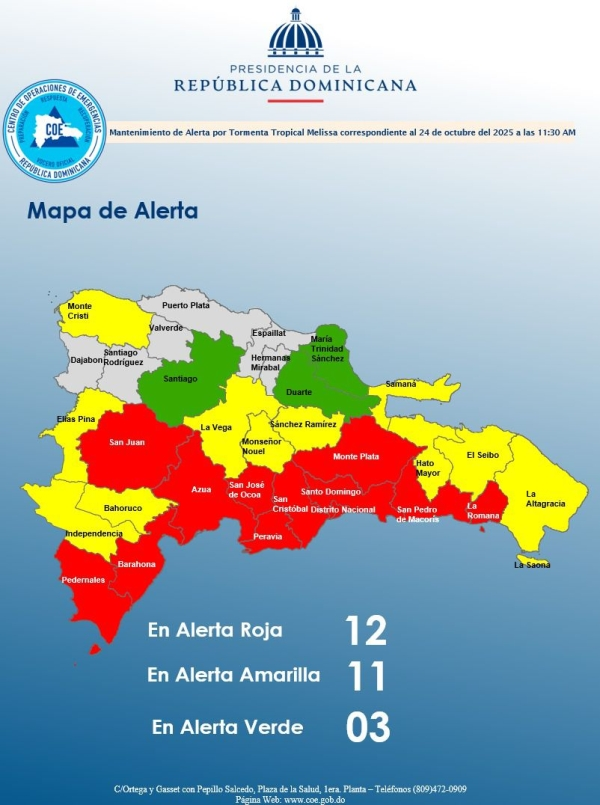
The storm exposes vulnerabilities and the losses could worsen the national economic outlook, after the IMF lowered its growth projection from 4.0% in April to 3.0% in October.
SANTO DOMINGO. – In just over three days, Tropical Storm Melissa is leaving a deep mark on the Dominican Republic, both socially and economically.
More than 1.1 million people have been affected by the interruption of the drinking water service due to the shutdown of 48 aqueducts, while hundreds have been evacuated and dozens of homes have suffered structural damage, according to bulletins from the COE and INAPA.
Meanwhile, economist Juan del Rosario estimates that economic losses could exceed $1 billion after more than 72 hours of partial shutdown, affecting key sectors such as commerce, transport, tourism, and construction.
With this data, Melissa exposes not only the fragility of water systems and urban infrastructure, but also the urgency of strengthening territorial resilience and reviewing emergency protocols for extreme weather events.
The cost of shutting down the country
Rosario, interviewed for Diario Libre, initially estimated that Melissa would cause economic losses of around US$510 million, based on the daily GDP (US$340 million) and 1.5 days of partial shutdown.
However, as of Friday, October 24, more than 72 hours had passed since the rains began, raising the economic impact to over $1 billion, not including structural damage or indirect losses. “If the weather conditions persist until Friday, the losses could exceed $1.3 billion,” del Rosario warned in the interview published on Thursday, October 23.
National economy: a difficult year
These losses could worsen the national economic outlook, considering that the International Monetary Fund (IMF), in its "Fiscal Monitor" report of October 2025, adjusted its growth projection for the Dominican Republic to 3.0%, below the 4.0% estimated in April.
Furthermore, he estimated that public debt would close the year at 60% of GDP, positioning the country as the sixth most indebted economy in Latin America. Finance Minister Magín Díaz acknowledged in statements to Listín Diario on October 22 that “2025 has been a difficult year,” although he asserted that “the Dominican Republic remains one of the strongest economies in the region.”.
Water, mud, and urgency
The number of people affected by the outages from the aqueducts exceeds 10% of the national population, which demonstrates the critical dependence on vulnerable systems in the face of flooding due to saturation caused by rain.
More than 180 homes were affected by flooding, landslides, or partial collapses, according to the COE (Emergency Operations Center). In areas such as Villa Jaragua and Enriquillo, the structural damage highlights the lack of territorial planning and the absence of building codes adapted to climate risk.
Experts from the Dominican College of Engineers, Architects and Surveyors (CODIA) warned in the press that the country needs to update its building regulations, especially in coastal and steep areas.
Tropical Storm Melissa has reopened the debate on constructive resilience, public investment, and municipal oversight. It wasn't the most intense storm, but it was certainly one of the most revealing.
The country needs to strengthen its water response capacity, review building codes and oversight, and ensure that every alert translates into action. Because every drop that falls on a weak system costs millions. And every home lost carries with it a story impossible to quantify.