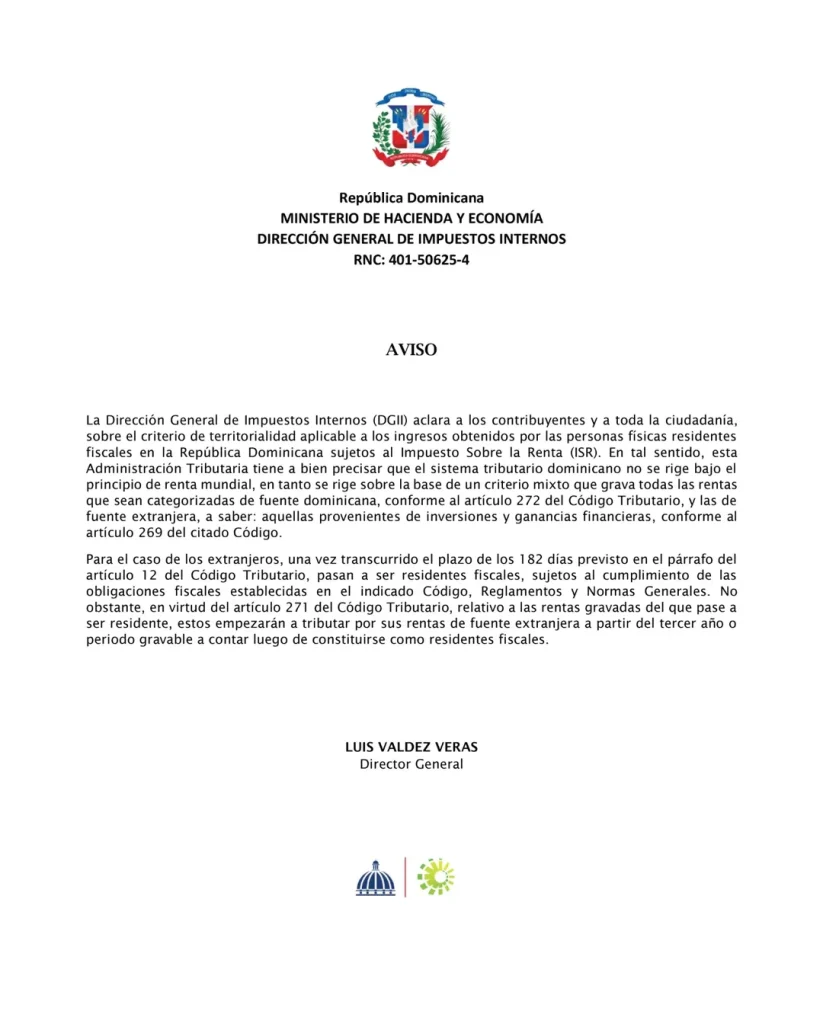
SANTO DOMINGO – The Dominican Republic's Internal Revenue Service (DGII) reported that the Dominican tax system is not based on the worldwide income principle, but rather on a mixed model that taxes both Dominican-source income and certain foreign-source income.
Through a notice, the entity clarifies the territoriality criterion applicable to Income Tax (ISR) for individuals who are tax residents in the Dominican Republic.
The agency explains that, according to Article 272 of the Tax Code, all income generated within the national territory is subject to taxation. However, it adds that Article 269 establishes that foreign income from investments and financial gains must also be taxed, meaning that tax residents are not exempt from declaring income earned outside the country if it comes from such sources.
The statement also clarifies that foreigners who remain in the country for more than 182 days in a calendar year are considered tax residents, in accordance with Article 12 of the Tax Code.
"This condition implies the obligation to comply with local tax regulations, including the declaration of certain income earned abroad," the tax authority points out.
However, the DGII points out that foreign-source income is not taxed immediately and that, according to Article 271 of the Tax Code, foreigners who acquire the status of tax residents will begin to pay taxes on their foreign income from the third fiscal year counted from their formal residence in the country.
The notice was signed by Luis Valdez Veras, general director of the DGII.