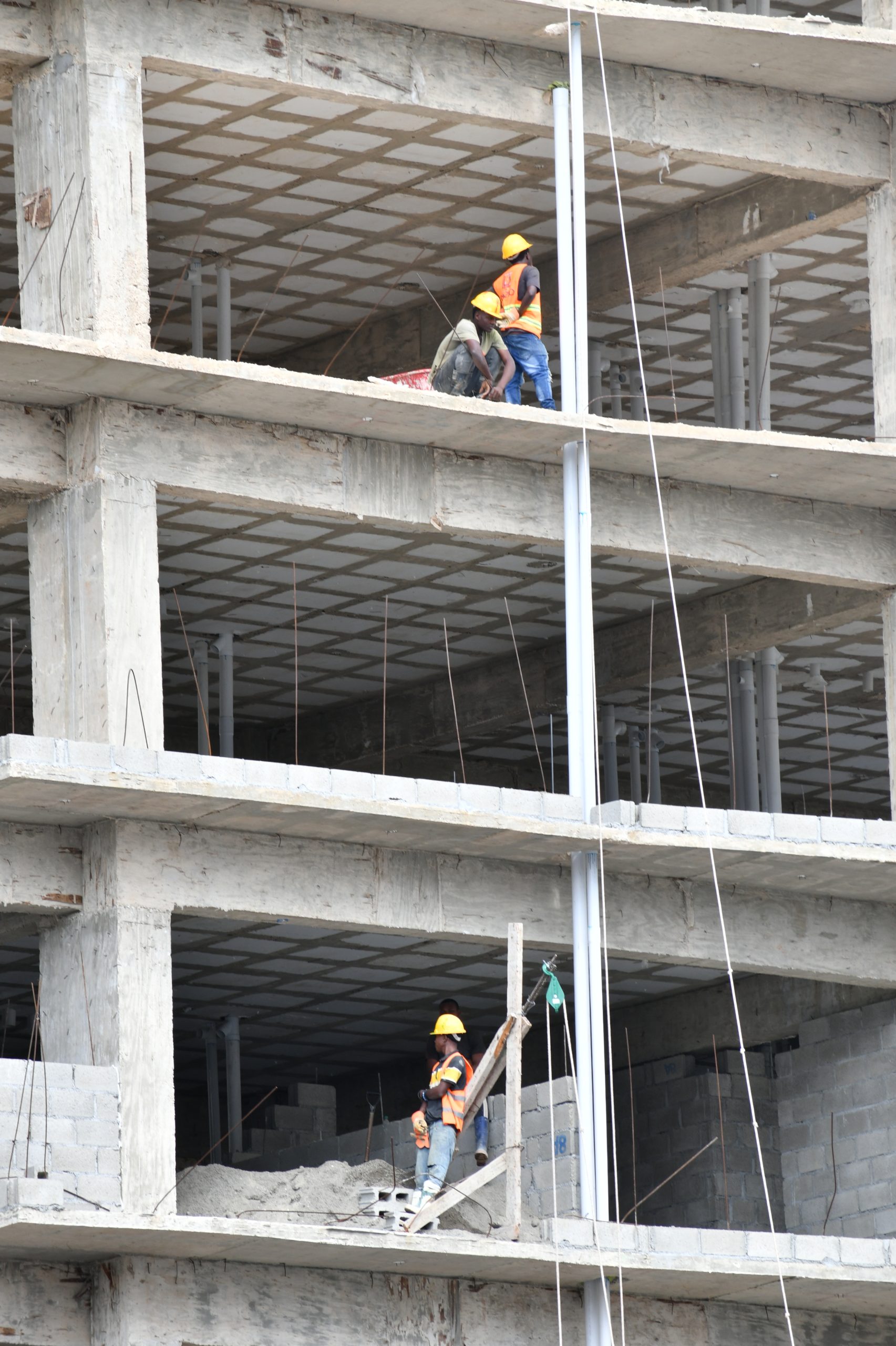
SANTO DOMINGO. - Following the delivery to President Luis Abinader of the final report on the Haitian crisis in the Dominican Republic, prepared by the Economic and Social Council (CES), representatives of the construction sector positively assessed the inclusion of the issue of regularizing Haitian labor in the country .
president of the Association of Housing Developers and Builders of Cibao (Aprocovici) , stated that addressing this situation was essential.
The engineer suggested that one of the measures that could be applied is the granting of permanent residency to foreigners who have been working "uninterruptedly" in the Dominican Republic for 10 to 15 years.
"He could have, under certain conditions if he has not committed any crimes and has had exemplary behavior, permanent residency," he specified.
The businessman considered this a common practice in various countries around the world where this type of residency is granted. In the case of those under 10 years of age, he suggested granting them temporary residency .
Regarding regularization, he indicated that there must be a follow-up prior to granting residency, requiring as a prerequisite proof of the company where one will work.
The president of Aprocovici added that this issue not only concerns the construction sector, but also agriculture and other economic activities in the country.
Regularize all foreign labor
Cristian Rojas, former president of the Dominican College of Engineers, Architects, and Surveyors (CODIA) , emphasized the importance of regularizing not only the employment of Haitian nationals, but also that of workers from other countries, including Venezuelans, Colombians, and Brazilians, who come to work in the construction sector.
“Logically, this would bring peace of mind to construction companies and private engineers who employ Haitian labor, which is the majority, and these workers would be able to work without worry,” he stated.
The civil engineer specified that, during the execution of the works, coordinated work must be carried out between the General Directorate of Migration and the Ministry of the Interior and Police to guarantee the corresponding control.
He also suggested that engineers and companies should provide workers with identification so they can perform their duties without problems.
“We are in complete agreement and I believe that the Dominican College of Engineers, Architects and Surveyors would be willing to collaborate in that aspect to regularize the nationals who come to work in this country,” he commented.
Dominicans refuse to work
For his part, Rafael Durán, a civil engineer with SBDS Investments , noted that Dominicans continue to refuse to carry out this type of work in the country, so he considered the delivery of this document "very appropriate".
“That is the kind of labor that Dominicans refuse to do in their own country. They do it in Puerto Rico, in the United States, in Europe, in South America, and in other Caribbean islands, but they refuse to do it here,” he said.
According to the engineer, the reality is that Dominicans claim "labor wages are very low." He explained that prices in the construction sector are determined by guidelines established by government institutions.
“It’s the price that is paid, that the economy pays. If the Ministry or the Department of Labor says that a job costs two thousand pesos a day, well, that’s what the State sets,” he clarified.
On the other hand, Durán stated that regularization is convenient and that, in case a person does not have a job, they would have to leave the country.
“One cannot be in this state of uncertainty, finishing a project and then suddenly immigration arrives and takes all the workers away,” the engineer commented.
Regarding the final report
The document, entitled “Consolidated Final Report of the Dialogue on the Haitian Crisis and its implications for the Dominican Republic” , was delivered last Tuesday afternoon at the National Palace.
According to the Presidency, the CES will present the report to the former presidents of the Dominican Republic on a schedule from September 10 to 16, with the report being made public on the afternoon of the latter day.