Along the long road to the heart of Australia, 848 km (527 miles) north of the coastal plains of Adelaide, lie scattered enigmatic sand pyramids. Around them, the landscape is utterly desolate: an endless expanse of salmon-pink dust, dotted with the occasional towering shrub.
But as you travel further along the road, more of these mysterious structures appear: mounds of pale earth, scattered randomly like long-forgotten monuments. Occasionally, a white pipe sticks out of the ground next to one of them.
These are the first signs of Coober Pedy, an opal mining town with a population of approximately 2,500 . Many of its small peaks are the wasteland of decades of mining, but they also reveal another local specialty: subterranean life.
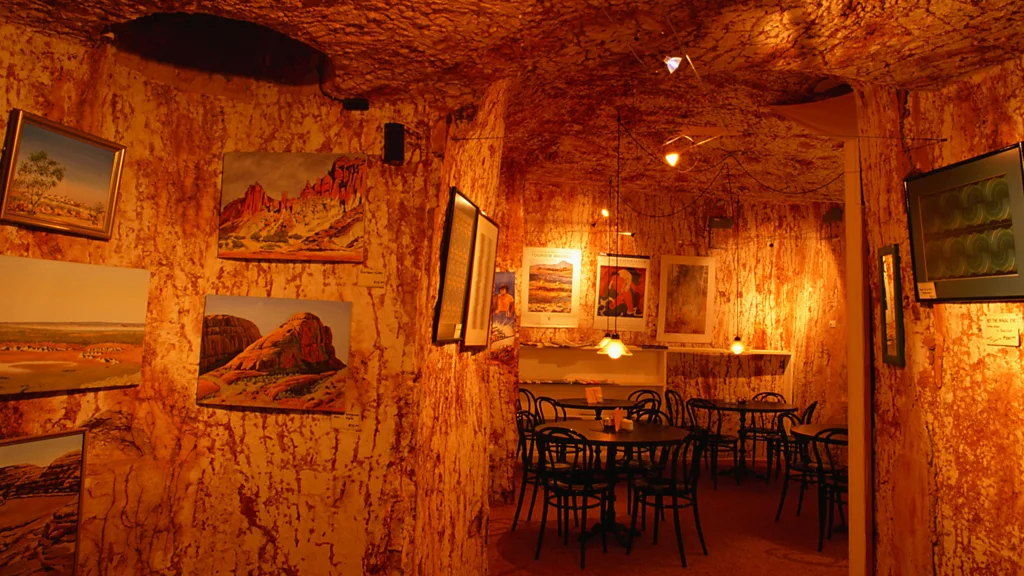
In this corner of the world, 60% of the population lives in homes built on iron-rich sandstone and siltstone. In some neighborhoods, the only signs of habitability are the protruding ventilation ducts and the excess soil dumped near the entrances.
In winter, this troglodyte lifestyle might seem merely eccentric. But on a summer day, Coober Pedy—a loose translation of an Indigenous Australian term meaning " white man in a hole "—needs no explanation: the temperature regularly reaches 52°C (126°F) birds have been known to , and electronic devices must be stored in refrigerators .
A long history
Coober Pedy isn't the world's first underground settlement, nor even the largest. People have sought refuge underground to cope with harsh climates for thousands of years, from our ancestors, who dropped their tools in a South African cave two million years ago , to Neanderthals, who created inexplicable piles of stalagmites in a French grotto during an ice age 176,000 years ago chimpanzees have been to help them withstand the extreme daytime heat of southeastern Senegal.
Let's take Cappadocia, an ancient district in central Turkey, as an example. The region sits atop an arid plateau and is famous for its striking, almost fantastical geology, with a landscape of sculpted pinnacles, chimneys, and rocky spires, like a fairytale kingdom. But what is truly spectacular is precisely what lies between these elements.
According to local lore, it all began with the disappearance of some chickens. In 1963, a man was digging in his basement when his poultry kept vanishing . He soon discovered they were disappearing down a hole he had accidentally dug, and after clearing the way, he followed them. From there, things got even stranger. The man had discovered a secret passageway: a steep underground path leading to a labyrinth of niches and other corridors. This was one of the many entrances to the lost city of Derinkuyu.
Derinkuyu is just one of hundreds of cave dwellings and several underground cities in the area, and is believed to have been built around the 8th century BC. It was inhabited almost continuously for millennia — with its own ventilation shafts, wells, stables, churches, storehouses and a vast network of underground dwellings — and also served as an emergency shelter for up to 20,000 people in case of invasion.
As in Coober Pedy, subterranean life helped the region's inhabitants cope with the continental climate, which ranges from hot, dry summers to freezing, snowy winters. While above ground the temperature varies from well below zero to over 30 °C (86 °F), underground the temperature is always 13 °C (55 °F).
Even now, the region's man-made caves are renowned for their passive cooling capabilities : a construction technique that involves using design choices rather than energy to minimize heat gain and loss. Today, Cappadocia's ancient galleries and passageways are filled with thousands of tons of potatoes, lemons, cabbages , and other produce that would otherwise require refrigeration. Demand is so high that new caves are being built .
An effective solution
Further along the road to Coober Pedy lies the main town. At first glance, it could be mistaken for any inland settlement: the streets are pink with dust, and there are restaurants, bars, supermarkets, and gas stations. On a hill overlooking it all stands the town's only tree, a metal sculpture. Coober Pedy is eerily empty. The buildings are widely spaced, and something feels off.
But underground, everything has an explanation. Some of Coober Pedy's "shelters," as they're known, are accessed through what appear to be ordinary little buildings; upon entering, their subterranean passageways are gradually revealed, like stepping through a wardrobe in Narnia. Others are more obvious: at Riba's, a campsite where you can camp in niches several meters underground, the entrance is a dark tunnel.
In Coober Pedy, underground buildings must be at least four meters (13 feet) deep to prevent their roofs from collapsing . Beneath this depth of rock, the temperature is always a comfortable 23°C (73°F). While residents above ground endure scorching summers and freezing winter nights, where the temperature regularly drops to 2-3°C (36-37°F), the underground homes maintain a perfect room temperature 24 hours a day, year-round.
Besides comfort, one of the main advantages of living underground is money. Coober Pedy generates all of its own electricity— 70% of which comes from wind and solar power —but air conditioning is often very expensive. “To live above ground, you pay a fortune for heating and air conditioning, when the temperature often exceeds 50°C (122°F) in the summer,” says Jason Wright, a resident and owner of Riba’s.
Source: BBC https://www.bbc.com/
Photo: Getty Images.