


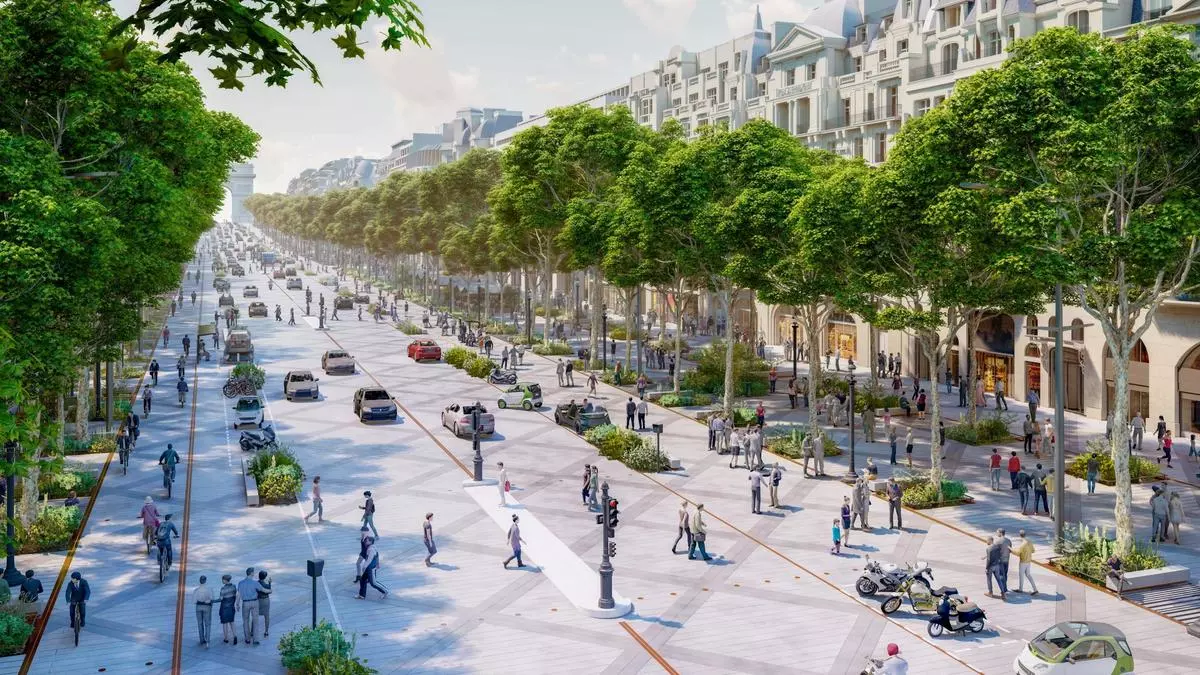
A "15-minute city" allows residents to meet their needs organized into six categories: living, working, shopping, healthcare, education, and entertainment.
The crisis caused by the coronavirus pandemic intensified the desire to live in towns, neighborhoods, and small cities of 'human scale'. This reality brought the concept of the "15-minute city" back into the spotlight, a more livable model oriented towards people, rather than cars.
The idea is to encourage a return to a local way of life, a model based on small, self-sufficient communities, where city dwellers have access to all their essential needs within a 15-minute walk or bike ride. In other words, improving quality of life through hyper-proximity.
The concept is based on the work done more than 100 years ago by the American planner Clarence Perry, rescued in the sixties by his compatriot Jane Jacobs, and redefined by the Franco-Colombian scientist Carlos Moreno.
This urban proposal was adopted in May 2020 by the C40 Cities Climate Leadership Group, a conglomerate of cities from around the world, including Madrid and Barcelona, that are joining forces to reduce carbon emissions and adapt to climate change. It was their response not only to the climate crisis but also to the urban effects of the COVID-19 pandemic.
The "15-minute city" is based on a vision of a polycentric city, a decentralized, sectorized structure that transcends the urban to encompass the territory, combining development and competitive cooperation at the economic, social and environmental level between its parts, all articulated through efficient communication networks.
Less pollution
A scientific study published in 2022 revealed that pollution spreads much more slowly among individuals in communities that follow this model, since most residents don't have to pass through the same pollution hotspots every day. And most don't even rely on public transportation, as they can walk or cycle to work, school, the local health center, or local shops.
Thus, by reducing the need for long journeys, not only is the circulation of viruses and pollution reduced, but local communities and economies are also strengthened.
This model also strengthens neighborly relations, which psychologists consider extremely important in situations like the one that occurred during the pandemic, in which human beings needed cooperation and care.
A "15-minute city" allows residents to meet their needs organized into six categories: living, working, shopping, healthcare, education, and entertainment.
But what are the essential services that must be within a quarter of an hour of all residents? For example, the workplace, the supermarket, the public park, the school, the doctor's office, the children's playground.
According to Carlos Moreno, scientific director of the Chair of Territory and Innovation at the Sorbonne University in Paris, the city should be an ally, an inspiration, and not an obstacle to living a fulfilling life. Therefore, he proposes improvements in urban design that foster healthier communities.
Instead of towns with distinct districts for living, socializing and working, as is currently the case in most large cities, Moreno's concept envisions the urban center as a tapestry of neighborhoods.
Regenerating urban neighborhoods
According to the scientist, the drastic shift towards remote work, accelerated by the pandemic, has demonstrated that the "15-minute city" is not only feasible but could be "crucial for regenerating urban neighborhoods." This involves creating entire neighborhoods by decentralizing basic services and developing a social and functional mix.
“There are many jobs that can be done remotely. Commuting for an hour to sit behind a computer in the office doesn't make much sense if you can sit behind a computer close to home. Being close to home means we can create new spaces,” Moreno points out.
Another of her proposals is to reimagine how existing infrastructure can be better utilized. “In a city like Paris, a building is in use 30% or 40% of the time. That means that for 60% or 70% of the day, the building is empty more often than it is in use.” She advocates for repurposing it to house activities different from those for which it was originally designed.
He gives examples: disused buildings could be converted into coworking or collaborative workspaces. Schools could open on weekends for cultural activities. A sports hall by day could become a nightclub by night. Cafes could host language classes in the afternoons, and public buildings could host concerts on weekends.
The "15-minute city" plan involves decentralizing services and reorganizing streets. This paradigm shift means moving away from giving 100% priority to cars and toward prioritizing pedestrians and cyclists.
In other words, the design should be centered on understanding the needs and desires of those who inhabit the spaces. That is, giving the streets back to the people and fostering human connection.
Cities that have adopted the model
Paris, under the administration of Anne Hidalgo and with the guidance of Carlos Moreno, was one of the first cities to implement a plan to foster the development of more self-sufficient communities. The 'Quarter-Hour City' aims to transform the metropolis into efficient neighborhoods, with the goal of reducing pollution and creating vibrant, dynamic areas.
Copenhagen has also followed this path: it has long since placed bicycles at the center of urban mobility.
Portland adopted an innovative climate action plan in the late 2000s: 20-minute neighborhoods. The goal is for 90% of its residents to be able to reach their basic needs on foot or by bicycle within that time by 2030.
Melbourne launched a building permit reform program to support housing diversity, funding for public art installations, recreational spaces, and the renewal of activity center streets.
Shanghai and Guangzhou, in China, also already have neighborhoods called "15-minute community living circles", in which their inhabitants can satisfy all their basic needs, at most, in that period of time.
Barcelona is committed to a system of 'superblocks' or 'superblocks' that modifies road networks into 400x400 meter blocks to improve the availability and quality of public space for leisure and community activities and for pedestrians and cyclists.
Criticisms: “The model will lead to tribalism”
But there are also critics of the "15-minute city" concept who predict that it will lead to tribalism and exacerbate existing urban disparities between neighborhoods.
Moreno's response is that cities are already very unequal today: “They are very fragmented, very segregated. We push a lot of people towards the suburbs, where housing prices are lower. And we tell them, ‘Take the train, it might take you an hour to get to work, and you can be thankful you have a job because the world belongs to those who get up early.’”.
“We cannot continue building further and further away and constructing three or four new train stations and telling people 'you have the option to come',” Moreno argues, asserting that the “15-minute city” will instead foster social cohesion, reduce inequality, and improve the quality of life in disadvantaged neighborhoods.
Cover photo: Future plans for the Champs-Élysées in Paris. / PCA_STREAM.







