Cleaning the house thoroughly, putting coins in your shoes, carrying lentils in your pockets, wearing yellow, red or green underwear, colors associated with money, love and health, burning the old year and running away dragging a suitcase, are some very Dominican activities.
SANTO DOMINGO – For decades, December 31st has been celebrated in two stages: the one behind closed doors and the one outside. It's a night of glitter, sequins, and all kinds of extravagance, and also one in which individual and collective traditions and rituals are explicitly revived.
Far from being isolated acts or mere superstitions, these rituals condense deep layers of history, popular religiosity and cultural identity, in which the home is the primary setting.
Things start even days before, with a thorough cleaning of the house, throwing away broken, useless, and unpleasant things, and traditionally, the interior and exterior painting of the house is even done before Christmas Eve, but it is also part of that belief that the new year should find the house spotless, "so that the grace of God may enter."
It's not just about tidying up. Sweeping "from the inside out," throwing out old clothes, or throwing out ammonia water all stem from the symbolic idea of expelling the negativity accumulated throughout the year. Similar practices have been frequently documented by the national press as part of the country's end-of-year cultural repertoire.
In addition to cleaning, there are prosperity rituals such as placing coins in shoes, carrying lentils in pockets, or wearing new clothes, especially yellow, red, or green underwear, colors associated respectively with money, love, and health.
Probably due to the high migration of Dominicans to Spain, it is increasingly common to find people who perform the ritual of eating 12 grapes at midnight, one for each month.
Sociologist and folklorist Dagoberto Tejeda explains that these actions must be understood within a broader cultural process, and in an essay on Dominican Christmas celebrations, he says that: “Christmas is a Christian holiday… however, in countries like ours, it has gradually been transformed because the religious, the symbolic, and the everyday are intertwined.”
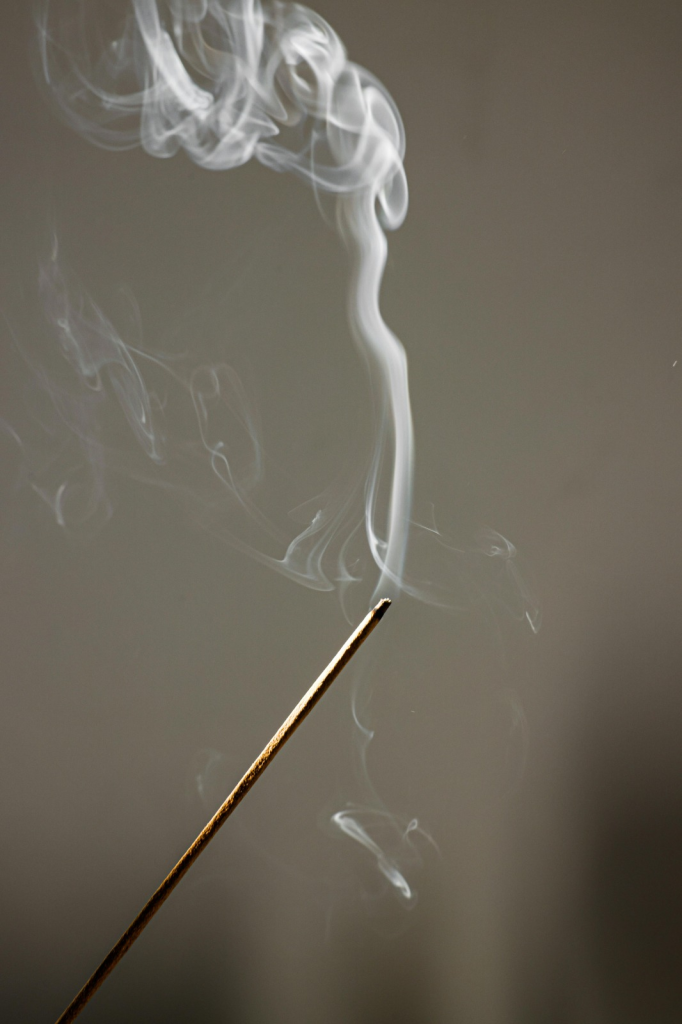
Fire here functions as a symbol of closure, renewal, and purification. (External source).
New Year's Eve on the streets
Although the term New Year's Eve is more commonly used in Spain, here it has gradually spread and taken on new meaning with local customs and traditions, including generational changes. And while the home is the primary ritual space, the street is the stage where the ritual becomes collective.
Until about five decades ago, in the streets of neighborhoods and countryside, fire took center stage with the burning of effigies, made of used clothing, cardboard or sawdust, which represented the year that ends, the "old year", while fireworks and music turned the closing of the calendar into a community experience.
Although less and less common, the burning of the "old year" still persists in neighborhoods of Greater Santo Domingo and the interior of the country, sometimes caricaturing public figures such as politicians; other times, they simply embody the bad things that people want to leave behind.
Various media outlets have documented this practice as a form of social catharsis, although also as an event that in recent years has been subject to regulations for safety reasons.
Fire here functions as a symbol of closure, renewal and purification, an idea present in multiple cultures for thousands of years, and which in the Dominican Republic takes on a festive character.
Long before travel became democratized, with affordable tours and open national border policies, rushing off while dragging a suitcase was a way to start the new year with a little trip. And it's still done, even in cold countries.
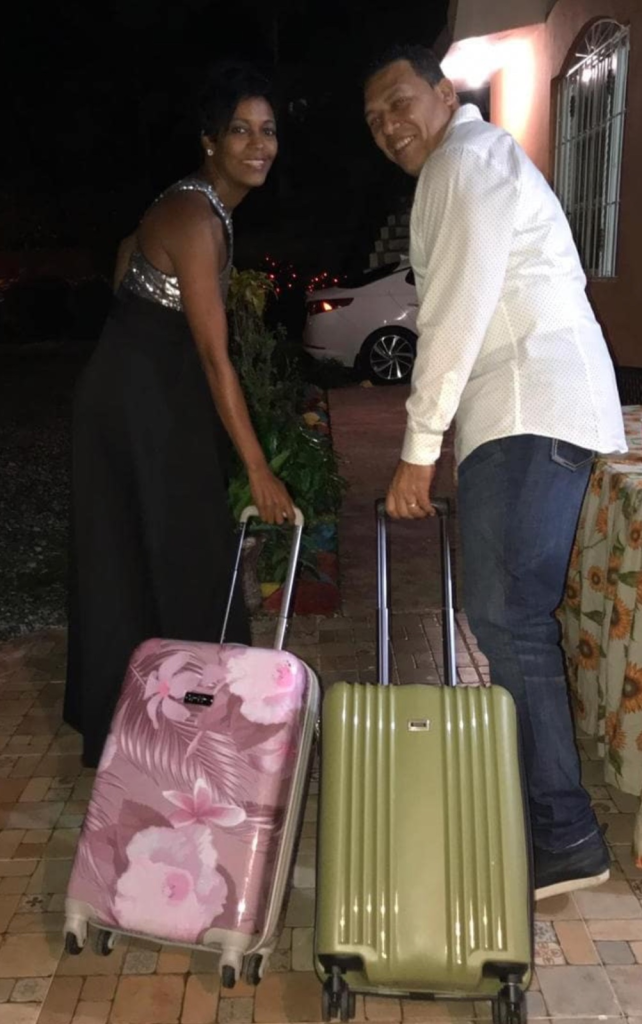
Running away while dragging a suitcase is a way to ensure you'll take a trip in the coming year. (External source).
And although it is now easier to leave the country, this custom remains, even in the vertical hives that have replaced single-family homes, and dozens of people can be seen in building parking lots, wishing each other a happy new year, dragging their little suitcases.
In working-class neighborhoods, the celebration is regularly complemented with loud music, fireworks, and spontaneous gatherings among neighbors, since the new year is not only welcomed with family: it is welcomed in community, in the street, the parking lot, the park, or at the shared party in the town square.
In upper-middle and upper-class neighborhoods, this celebration has retreated into the private sphere: family dinners, television, series, and an intimate toast. The streets, once a stage for hugs and music, have gradually faded away.
Syncretism and popular religiosity
Beyond the visible rituals, the Dominican New Year also reveals the persistence of religious syncretism. Catholic prayers, vows, spiritual cleansings, and practices inherited from Afro-Caribbean traditions coexist peacefully in daily life.
Sociologist Carlos Andújar Persinal , one of the leading scholars of popular religiosity in the country, has documented how these expressions are part of the same cultural matrix, in which Catholicism and Afro-descendant culture are integrated into common and socially accepted practices.
Research and essays on popular religiosity indicate that Catholic prayers, protection rituals, and symbolic cleansings, such as "smudging" at midnight, tend to intensify during transitional times in the calendar, such as the end of the year.
Ritual, uncertainty and identity
You don't know why you still follow these routines, but at midnight on December 31st you light a small piece of charcoal, even if it's just on the lid of an old pot, and throw incense and sometimes myrrh into the fire. Globalization has brought the incense sticks used in the East, and it's no longer necessary to risk damaging your home.
And if you don't have an incense burner, if you live in the capital, on some corners of 27 de Febrero, as with Núñez de Cáceres, street vendors will offer you the complete kit: the little tin burner and the little sachet of incense.
From the perspectives of sociology and anthropology, these rituals serve clear functions: they help manage uncertainty about the future, reinforce social cohesion, and allow people to feel symbolic control over what they cannot foresee.
In a context marked by economic crises, migration and accelerated changes, ritual becomes an anchor and wherever the Dominican goes, whether to Alaska, Europe or Patagonia, he repeats in some way one or all of the rituals he learned.
As Dagoberto Tejeda points out in various analyses of popular culture, festivals and rituals are not simply folkloric expressions: they are mechanisms of identity affirmation, spaces where society recognizes itself and updates its collective memory.
One year goes by, one culture remains
As the clock strikes twelve, to put it mildly because here you only hear the roar of fireworks, loud music and the boisterous embraces, when the burned effigies are extinguished and the doors that were thrown wide open to let out the old are closed, the Dominican Republic enters a new year without breaking with the previous one.
Domestic and community rituals do not promise magical solutions, but they offer something equally valuable: cultural continuity, a sense of belonging, and the shared hope that what is to come may be better.
In that balance between the broom, the ammonia, the suitcase and the fire, between the family table and the neighborhood street, the country narrates itself again, year after year.