BBC News World
It circled the globe in just minutes.
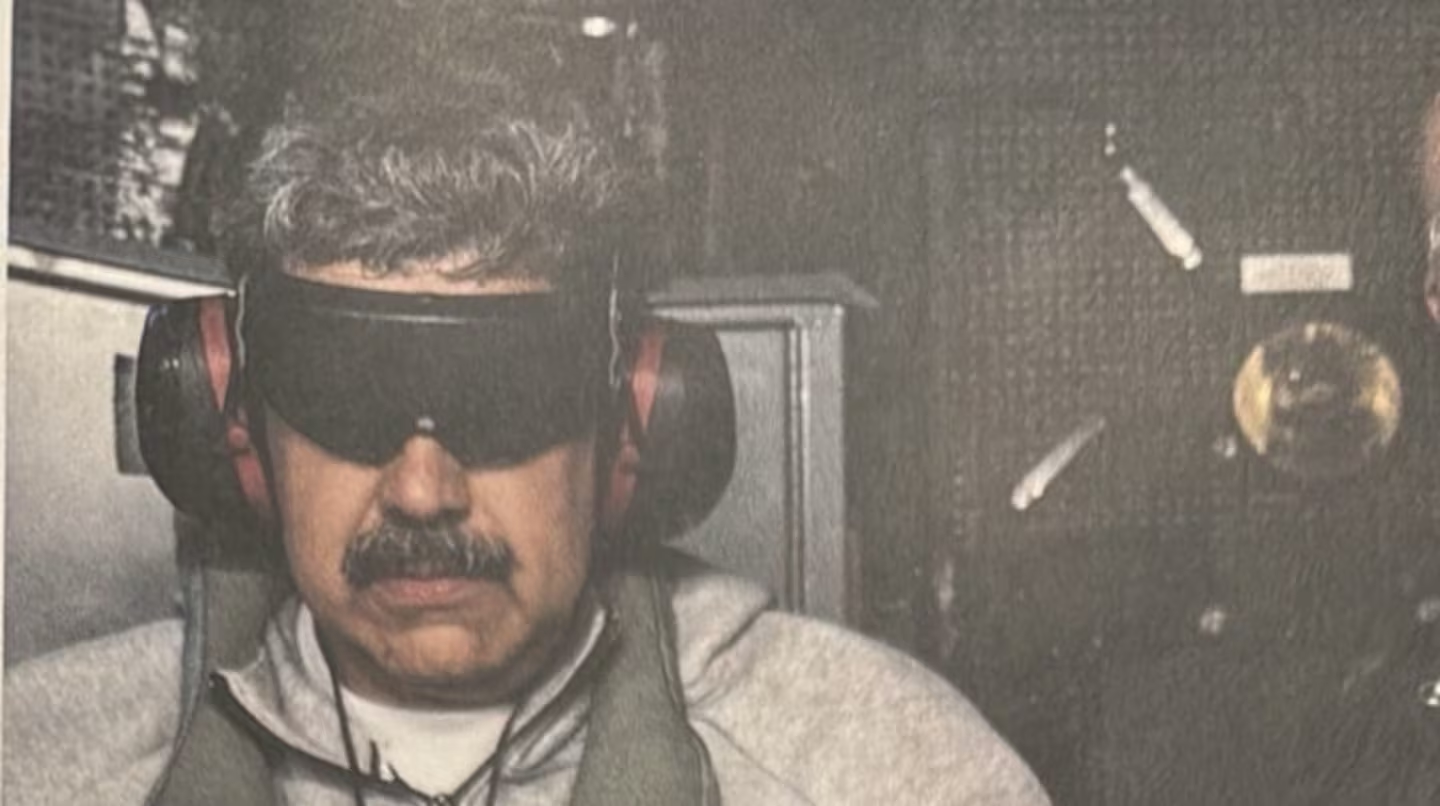
The first image of Nicolás Maduro after being detained in a US military operation this Saturday will remain in the memory of many.
The photographic record was released just hours after elite US troops arrested the man who had been the leader of the Venezuelan regime since 2013, in an operation ordered by Donald Trump himself.
It was Trump himself who shared the photograph of Maduro on the Truth Social network, at a time when the then Vice President of Venezuela, Delcy Rodríguez, was asking for proof of life after the capture of the president and his wife.
So far it is known that Maduro and his wife, Cilia Flores, were arrested in the early hours of the morning at Fort Tiuna, in southwest Caracas, and were then transferred by helicopter to the warship Iwo Jima to be taken -via Cuba- to New York.
There, both will face US justice on charges of conspiracy to commit narcoterrorism, conspiracy to import cocaine into the US, and other weapons-related offenses.
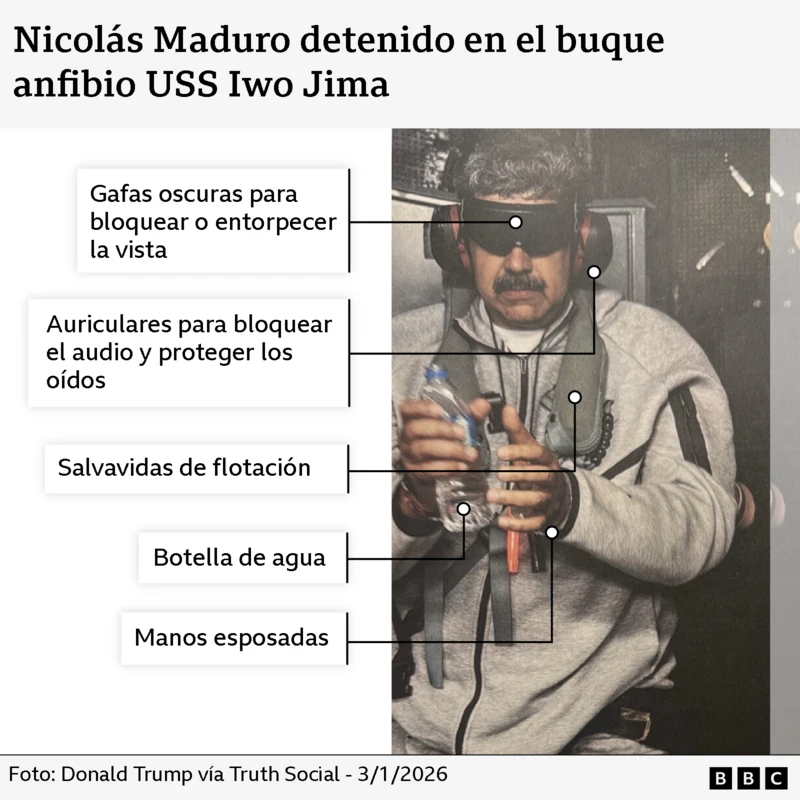
At BBC Mundo we consulted defense and military operations experts about what conclusions can be drawn from that first image in which Maduro is seen wearing sportswear, with his hands apparently handcuffed and with his senses, such as sight and hearing, blocked.
Common techniques
According to Mark Cancian, a retired U.S. Marine Corps colonel and senior advisor to the Department of Defense and Security at the Center for Strategic and International Studies (CSIS), "the government has treated this arrest as a law enforcement matter, not a military operation, and has treated Maduro as a detainee.".
"That is seen first in the rhetoric and also in the treatment: he is captured, transferred to detention centers, and all the procedures that would be applied to any prisoner accused of a crime are applied to him," he adds.
According to experts, in that context, it would be common practice - particularly in the United States - to block senses such as sight and hearing in operations of this nature.
"These are common detention techniques used in military apprehensions, which serve both to silence or isolate the detainee and prevent them from communicating with others, and to protect mission security by preventing the detainee from learning about the methods, personnel, locations, and capabilities employed during the operation," says John Spencer, a U.S. expert on military operations and urban warfare and chair of Urban Warfare Studies at the Modern War Institute at West Point.
Matthew Savill, director of Military Science at the Royal United Services Institute (RUSI), the world's oldest and the UK's leading center for Defence and Security studies, agrees that these protocols are based on tactical reasons.
"Most likely, it's done to make him more subdued and less likely to escape, and also to make it harder for him to identify any of the Delta Force team members involved in his capture," he argues.
Some analysts, however, have pointed out that Maduro's use of headphones may simply be due to the helicopter trip he took when he was transferred to the Iwo Jima warship, where this type of protection is required by protocol.
Another element of the image is the water bottle that Maduro is holding in his hands.
"I consider it a standard health and safety measure for detainees; they need water. I think that's a fairly standard measure," Cancian maintains.
Life jacket
The image also shows Nicolás Maduro with an item around his neck.
According to experts consulted by BBC Mundo, it is an inflatable life preserver, like those typically used on aircraft and in the navy as a safety measure in case of passenger contact with water.
The life jacket appears to have a manual inflation system and one with CO2 bottles, which are perceived as small black balls around the vest.
In addition, some analysts point out the orange and black labels that can be seen behind his hands.
These would be chemical lights, which glow in the dark, and are usually placed on passengers when there is movement at night on the flight deck to make them easier to identify.
Unprepared?
But the image of Maduro also suggests the context in which he was arrested.
The position of his hands suggests that he is apparently handcuffed, and his clothing - a sports outfit - indicates that the operation may have caught him off guard at that late hour of the night.
This coincides with the version given by President Donald Trump, who assured that both Maduro and his wife were captured while trying to lock themselves in a secure room at Fort Tiuna.
"I was trying to get to a safe place, which wasn't, because we would have blown the door off in about 47 seconds," Trump said.
"He got to the door. He couldn't close it. He was subdued so quickly that he didn't even get into that room," he added.
*Image with annotations by Daniel Arce-López, from the BBC Mundo Visual Journalism Team.