


It is estimated that it will require an investment exceeding USD 500 million and the first offices will open in approximately two years.
A city made entirely of wood is possible thanks to architectural and technological advancements. Atrium Ljungberg, the company behind the project, expects Stockholm Wood City in Stockholm, Sweden, to begin construction in 2025, with the first buildings completed by 2027.
This is how it is planned to become the world's largest wooden city. It will have an impressive area of 250,000 square meters and will incorporate various types of construction. There will be 7,000 offices and 2,000 homes, as well as diverse shops, businesses, and restaurants, to foster social and economic activity.
Experts argue that this trend is here to stay. Today, the transformation towards a more sustainable world represents the greatest post-pandemic challenge. It is even suggested that the transformation of major cities presents a valuable opportunity to rethink the economy and ensure a more sustainable future.
Daniel Lassalle, manager of the Argentine Chamber of Wood (CADAMDA), told Infobae that “wooden skyscrapers made from renewable resources, vertical forests rising in urban areas, the substitution of non-renewable materials such as plastics, steel or concrete with renewable bio-based materials, or the transformation of gray infrastructure into green infrastructure, are just some of the innovative ideas that this paradigm shift brings.”
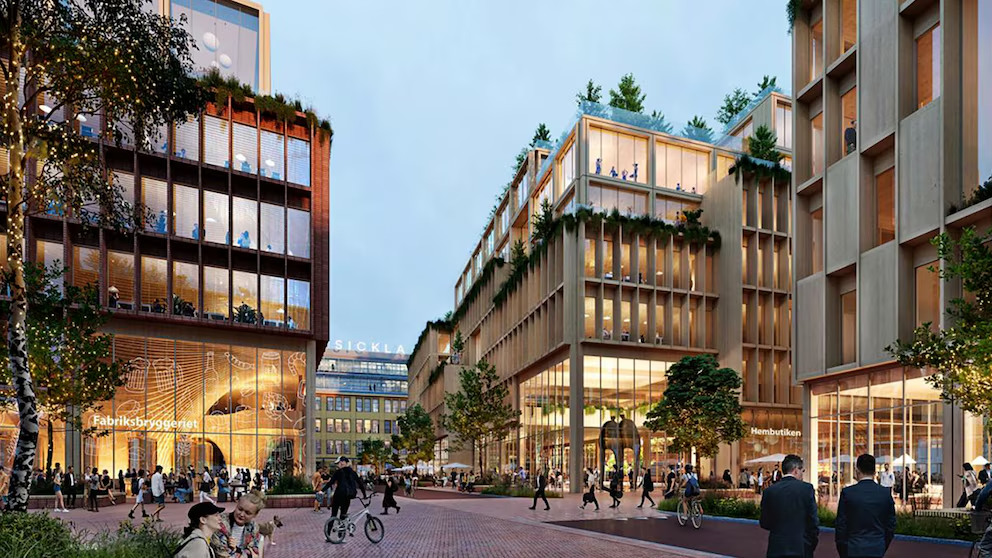
The so-called Biocity will have 7,000 offices and 2,000 homes.
Sweden—along with all the Nordic countries, Canada, the United States, and Japan, among others—is a pioneer in this project and in wood construction in general. Its standards are very demanding in terms of sustainability and well-being. In this respect, the most prominent trends in sustainable architecture worldwide include wood as a primary building material.
Stockholm Wood City is destined to become a turning point in sustainable architecture and urban planning. Located in Sickla, south of the Swedish capital, it is estimated to require an investment exceeding USD 500 million, with the first office properties expected to open in approximately two years.
“We are proud to present Stockholm Wood City. It is not only an important step for us as a company, but a historic milestone for Swedish innovation,” said Annica Ånäsof the development company Atrium Ljungberg in a statement.
Cities are both the cause and the solution in the fight against climate change. Responsible for 70% of carbon emissions, urban areas are now home to 55% of the world's population, with more than 4.2 billion inhabitants.
Experts argue that this trend will continue to grow: by 2050, it is estimated that 7 out of 10 people—out of the world's 9.7 billion inhabitants—will live in cities. Metropolises will absorb almost all of the world's future population growth.
This goes hand in hand with the new needs of living in these cities. How to achieve environmentally friendly practices and customs, how to choose the least harmful materials, how to change habits, learn to reduce our carbon footprint, and cultivate new forms of social connection. Simple, with wood.
In Argentina and throughout the region, CADAMDA is leading the promotion of the use of this material for all types of construction, from private homes and buildings to bridges and even entire cities. Climate-smart city projects—bio-cities—are multiplying worldwide.
Research reveals that 50% of the urban fabric needed to meet demand by 2050 still needs to be built. Building using only steel and concrete accounts for more than 10% of global carbon emissions. Developers and builders are considering wood as an efficient material for social transformation, as it is the only building material that is renewable and can be sustainably cultivated, and it also captures carbon. Every square meter of wood-based product stores one ton of CO2 and prevents the production of more than two tons of CO2 compared to other materials.
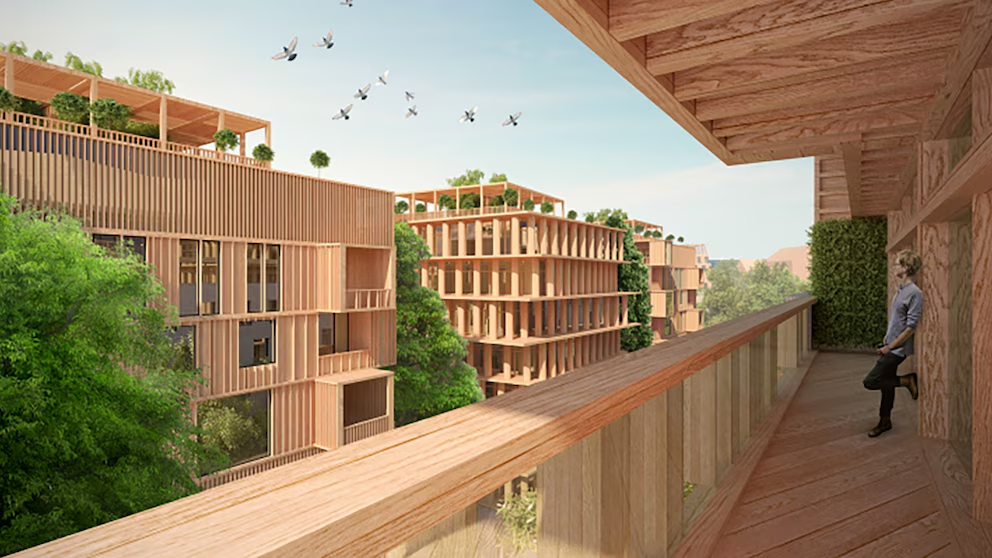
From a balcony of a house.
“Wood will play a leading role in the challenge of transforming large cities into more sustainable places through the bioeconomy. In fact, cities that use wood in construction become carbon capture and storage infrastructures. Furthermore, parks and the strategic placement of trees around buildings reduce energy consumption for heating and cooling. Therefore, wood, trees, and forests are the backbone of climate-smart cities called biocities,” said Lassalle.
Why with wood?
In the specific case of Biocities, there are several aspects to consider. Beyond its obvious sustainability characteristic, wood – compared to steel and concrete – has a lower environmental impact and, especially during periods of intense wildfires and heat waves in the Northern Hemisphere – is more fire-resistant.
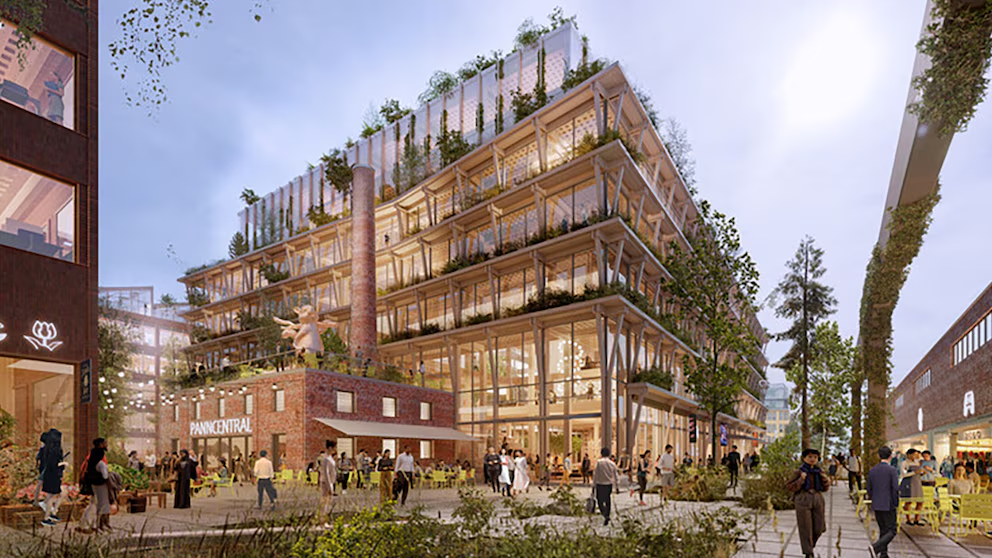
There will also be shopping and public promenades.
Furthermore, it is a renewable, recyclable, and carbon-neutral or positive product. It provides raw materials for essential products such as housing, furniture, paper, energy, and chemicals, replacing, in many cases, the use of non-renewable products derived from mining and fossil fuels. With new technologies, such as nanotechnology and biorefineries, countless other applications are being added.
Timber structures offer numerous benefits for the environment, human health, and overall well-being. Many studies have shown that timber structures have superior air quality, lead to lower stress levels and higher productivity, and can store carbon dioxide. Stockholm Wood City also incorporates several additional environmental advantages beyond the inherent benefits of wood.
There are other examples around the world of cities with a large presence of wooden housing, but the one to be built in Sweden will be entirely constructed with this material.
Source: Infobae. https://www.infobae.com/







